Quick Facts
Formation & Origin
Malachite is a secondary copper mineral - it doesn't form from magma or deep in the Earth's crust, but rather in the oxidation zone above copper ore deposits, where copper-rich groundwater reacts with carbonate minerals and atmospheric carbon dioxide.
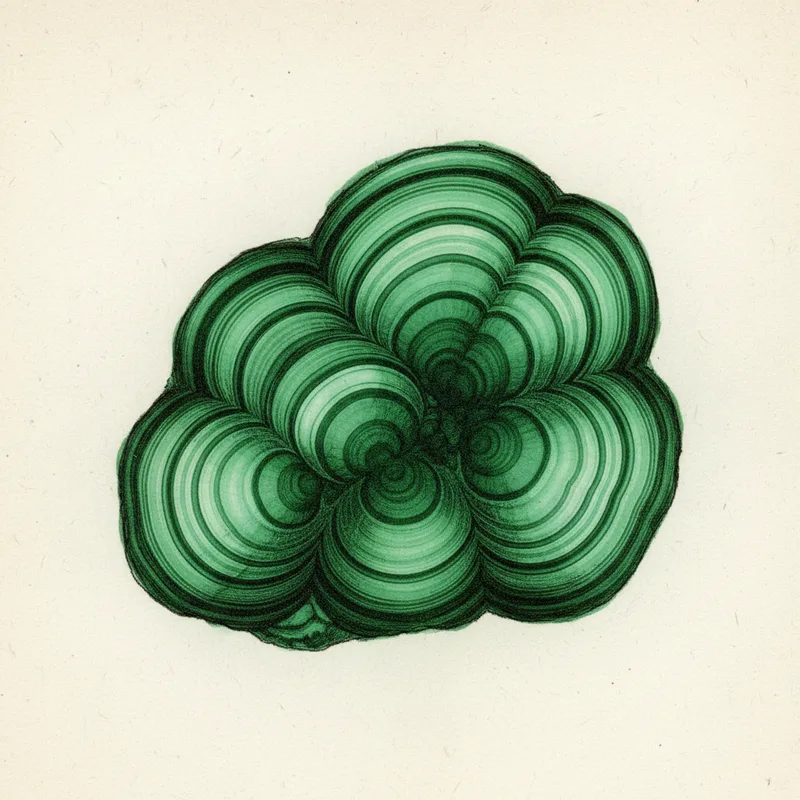
As copper-bearing solutions percolate through limestone and other carbonate rocks, malachite precipitates in layers, building up the distinctive concentric banding pattern that makes polished malachite so striking. Each band represents a separate episode of deposition, like tree rings recording time. The vivid green color comes directly from the copper content - malachite is about 57% copper by weight.
In the Ural Mountains of Russia, enormous malachite deposits were discovered in the 18th century, and the material was used on a lavish scale - entire rooms in the Hermitage Museum are decorated with malachite columns, vases, and wall panels. The deposits were largely exhausted by the mid-19th century, making Ural malachite specimens historically significant.
Identification Guide
Malachite is one of the most easily identified minerals thanks to its vivid green color, distinctive banding pattern, and effervescence in hydrochloric acid (a carbonate mineral test). No other common mineral combines all three.
At 3.5 on the Mohs scale, malachite is quite soft and can be scratched by a copper coin. Its botryoidal (grape-like) crystal habit is common, and when sliced and polished, the concentric banding of light and dark green is unmistakable. Malachite frequently occurs alongside azurite (blue copper carbonate) - the two often form striking blue-green combinations.
Spotting Fakes
Fake malachite is surprisingly common in the bead and jewelry market. Reconstituted malachite (ground and reformed with resin) has banding that looks too uniform and regular compared to natural material. Plastic imitations feel warm and lightweight. Glass imitations lack banding entirely. The best test: natural malachite's banding is always slightly irregular, with variations in band width and curvature. If the pattern looks computer-generated in its regularity, it probably is synthetic. Also note: malachite dust is toxic - never inhale it when cutting or polishing, and wash hands after handling raw specimens.
Cultural & Metaphysical Traditions
Presented as cultural traditions, not scientific evidence
Ancient Egyptians associated malachite with the afterlife and used it as eye paint (kohl). Russian czars considered it a symbol of wealth and power - the Malachite Room in the Winter Palace is one of the most famous examples of decorative stone use in history. In Italian Renaissance tradition, malachite was worn to protect children. Modern practitioners associate it with emotional transformation and breaking unhealthy patterns.
Where It's Found
World's most important commercial source today
Historic source, used in the Winter Palace columns
Vivid specimens, often with azurite
Exceptional botryoidal specimens from a legendary mine
Price Guide
Good to Know
Scratch test: At hardness 3.5, Malachite can be scratched with a copper coin. Handle gently and keep away from harder stones in your collection.
Sources: Found in 4 notable locations worldwide, from Congo (DRC) to Namibia.
Heft test: Malachite has a specific gravity of 3.80 - noticeably heavier than quartz. You'll feel the density when you pick it up.
Explore More
Carbonate Minerals
The Protection Collection
Ancient Egyptians associated malachite with protective goddess Hathor. Used as eye paint partly for its perceived protective qualities.
The Abundance Collection
Used as a merchant's talisman in the Middle Ages. Its banded green patterns were associated with growing wealth.
The Manifestation Collection
Transformation stone. Its concentric banding represents layers of growth. Associated with manifesting change in specific, concrete areas of life.
The Healing Collection
Ancient Egyptians ground malachite into paste for wounds and eye treatments. Copper content gives it genuine antimicrobial properties - one of the few healing crystal traditions with a plausible chemical basis.
The Travel Collection
The aviation stone in modern practice. Its banding resembles turbulence and flight paths. Ancient Egyptian travelers wore it as protection. Associated with safe transitions between very different environments.
Malachite vs Chrysoprase: Two Very Different Greens
Taurus Season Crystals: 6 Stones for Stability and Abundance
Turquoise vs Chrysocolla: The Copper Mineral Mix-Up
Mohs Hardness Scale
See where Malachite sits on the scale
Crystal Care Guide
Water safety, sunlight, and handling tips
Stay in the loop
From the Almanac
Updates from Crystal Almanac, when there’s something worth sharing.