Quick Facts
Formation & Origin
Diamond crystallizes from carbon at extreme pressures (50,000+ atmospheres) and temperatures (1,000-1,300 degrees Celsius) found 150-200 kilometers below Earth's surface, deep in the upper mantle. These conditions exist beneath ancient continental cratons - the oldest, thickest, most stable portions of continental crust.
Diamonds reach the surface through rare, explosive volcanic eruptions called kimberlite and lamproite eruptions. These eruptions originate deep in the mantle and travel upward at speeds exceeding the speed of sound, carrying diamond-bearing rock to the surface in pipe-shaped volcanic structures. The speed matters - slow ascent would allow diamonds to convert to graphite (the stable form of carbon at surface conditions).
Most diamonds are between 1 and 3.5 billion years old. They formed in the Archean and Proterozoic eons, long before complex life existed. Some diamonds contain inclusions of minerals that no longer exist anywhere else accessible on Earth, making them time capsules preserving evidence of ancient mantle chemistry.
Identification Guide
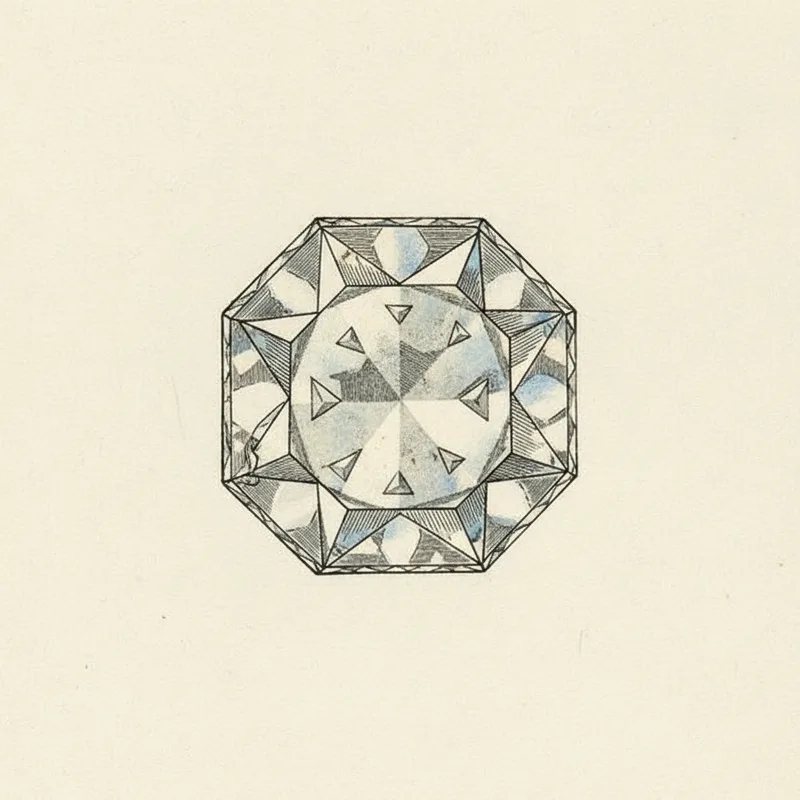
Diamond is identified by its supreme hardness (10 - nothing else comes close), adamantine luster, cubic crystal form (commonly octahedral), and high refractive index that produces the characteristic 'fire' (spectral dispersion) in faceted stones.
Distinguish from cubic zirconia (lower hardness at 8.5, higher dispersion), moissanite (double refraction, different specific gravity), and white sapphire (lower dispersion, no fire). Diamond's hardness is absolute - it can only be scratched by another diamond.
Spotting Fakes
The diamond simulant market is huge. Cubic zirconia (CZ) is the most common - it's denser than diamond, so the same size stone weighs more. Moissanite is a more convincing simulant with similar hardness (9.25) but shows double refraction (doubled facet edges visible through the stone). Lab-grown diamonds are chemically identical to natural and require specialized equipment (UV fluorescence imaging, spectroscopy) to distinguish. For any significant diamond purchase, insist on a GIA, AGS, or IGI grading report.
Cultural & Metaphysical Traditions
Presented as cultural traditions, not scientific evidence
The name comes from the Greek 'adamas' meaning unconquerable. Ancient Indians were the first to mine diamonds (3,000+ years ago) and associated them with Vajra, the thunderbolt weapon of the god Indra. Diamonds were believed to provide protection in battle and were worn uncut until faceting techniques developed in the 14th century. The De Beers marketing campaign 'A Diamond is Forever' (1947) is considered the most successful advertising slogan of the 20th century.
Where It's Found
World's most valuable diamond mines by output
Largest producer by volume, Mirny and Udachny mines
Historic discovery sites, legendary large diamonds
Was the world's primary source of pink and red diamonds
Price Guide
Good to Know
Scratch test: At hardness 10, Diamond can scratch glass and steel. It's durable enough for any type of jewelry.
Sources: Found in 4 notable locations worldwide, from Botswana to Australia.
Heft test: Diamond has a specific gravity of 3.52 - noticeably heavier than quartz. You'll feel the density when you pick it up.
Related Minerals
Same element (carbon), different crystal structure
Silicon carbide, closest simulant in properties
Hexagonal carbon, theoretically harder than diamond
Historic diamond simulant, natural mineral
Explore More
Native Elements & Metals
How to Tell Real Tourmaline from Glass and Plastic: 9 Tests
Ruby vs Garnet: The Red Stone Showdown
Carnelian: Meaning, Properties, and How to Use It
Mohs Hardness Scale
See where Diamond sits on the scale
Crystal Care Guide
Water safety, sunlight, and handling tips
Stay in the loop
From the Almanac
Updates from Crystal Almanac, when there’s something worth sharing.