How to Tell Real Tourmaline from Glass and Plastic: 9 Tests
Key Takeaway: Real tourmaline shows pleochroism (color shift when rotated), has a hardness of 7-7.5 on the Mohs scale, grows in a diagnostic rounded triangular prism with vertical striations, feels cool to the touch, and contains needle-like inclusions rather than round bubbles. No single test is definitive. Use at least three together, and for high-value varieties like Paraiba tourmaline, always get a gemological lab report.
Tourmaline is one of the most chemically complex minerals on Earth. Its general formula, Na(Li,Al)₃Al₆(BO₃)₃Si₆O₁₈(OH)₄, is a mouthful for good reason. That complexity produces an extraordinary range of colors, from jet black schorl to neon blue Paraiba, from pink rubellite to the green-and-pink zonation of watermelon tourmaline. And that range of colors is precisely what makes tourmaline a target for fakers.
The more varieties a mineral has, the more opportunities exist for substitution. Black tourmaline gets replaced with dyed glass and plastic. Paraiba tourmaline gets imitated with coated topaz and synthetic spinel. Watermelon tourmaline gets faked with layered glass. And plenty of "tourmaline" beads on the market are just dyed quartz or reconstituted material bound with resin.
Here are nine tests to identify natural tourmaline vs fake glass, plastic, and dyed substitutes, starting with the easiest and progressing to those requiring basic equipment.
1. The Pleochroism Test (The Best Free Test)
This is the single most useful test for tourmaline, and you don't need any equipment beyond your eyes and a light source.
Tourmaline is strongly pleochroic, meaning it displays different colors or color intensities when viewed from different angles. Hold your stone up to a bright light and slowly rotate it. In a genuine tourmaline crystal, you should see the color shift or intensify as you turn it. A green tourmaline might shift from deep forest green to a lighter yellowish-green. A pink rubellite will shift between lighter and darker pink tones. Indicolite shifts between blue and blue-green.
Glass, plastic, and dyed quartz do not show pleochroism. They look the same from every angle. If your stone shows zero color variation when rotated under a light, that's a significant red flag.
For a more precise version of this test, use a dichroscope. This small, inexpensive tool (around $15-30) splits the light passing through a transparent stone into two beams. In tourmaline, those two beams will show distinctly different colors or tones. In glass, both beams look identical. A dichroscope is one of the best investments for anyone who buys colored gemstones regularly.
One caveat: black tourmaline is too opaque for this test. For black specimens, skip ahead to the hardness, thermal, and magnification tests below.
2. The Hardness Test
Tourmaline sits at 7 to 7.5 on the Mohs hardness scale, which makes it harder than most common fakes. Here's what that means in practice.
A steel knife blade (hardness 5.5) will not scratch tourmaline. If your knife leaves a visible scratch, the stone is not tourmaline. It might be glass (hardness 5-5.5), dyed howlite (hardness 3.5), or plastic (hardness 1-3).
Conversely, tourmaline will easily scratch glass. Hold your stone firmly and drag a corner or edge across a glass bottle or old windowpane with moderate pressure. Genuine tourmaline leaves a visible scratch. Glass and plastic fakes will not scratch glass, or they'll scratch it poorly compared to real tourmaline.
Always test on an inconspicuous area of the stone, like the base of a specimen or near a drill hole on beads. And remember that this test doesn't distinguish tourmaline from other hard minerals like quartz (hardness 7) or topaz (hardness 8). It rules out glass, plastic, and soft stone substitutes.
3. The Thermal Conductivity Test
Real minerals conduct heat differently than glass and plastic. Pick up the stone and press it against the inside of your wrist or your cheek. Genuine tourmaline feels noticeably cool and takes several seconds to warm up to your body temperature. Glass feels cool initially but warms up much faster. Plastic never feels cool at all.
This is the same temperature test described in our complete guide to spotting fake crystals, and it works well as a quick first check. It won't distinguish tourmaline from other genuine minerals, but it reliably catches glass and plastic imposters.
For a more precise version, jewelers use a thermal conductivity tester (sometimes called a "diamond tester" in its basic form). These devices measure how quickly heat moves through a material. Tourmaline has a distinct thermal signature that differs from glass, synthetic spinel, and most other common substitutes.
4. The Magnification Test
Under 10x magnification (a standard jeweler's loupe), natural tourmaline and glass look dramatically different inside.
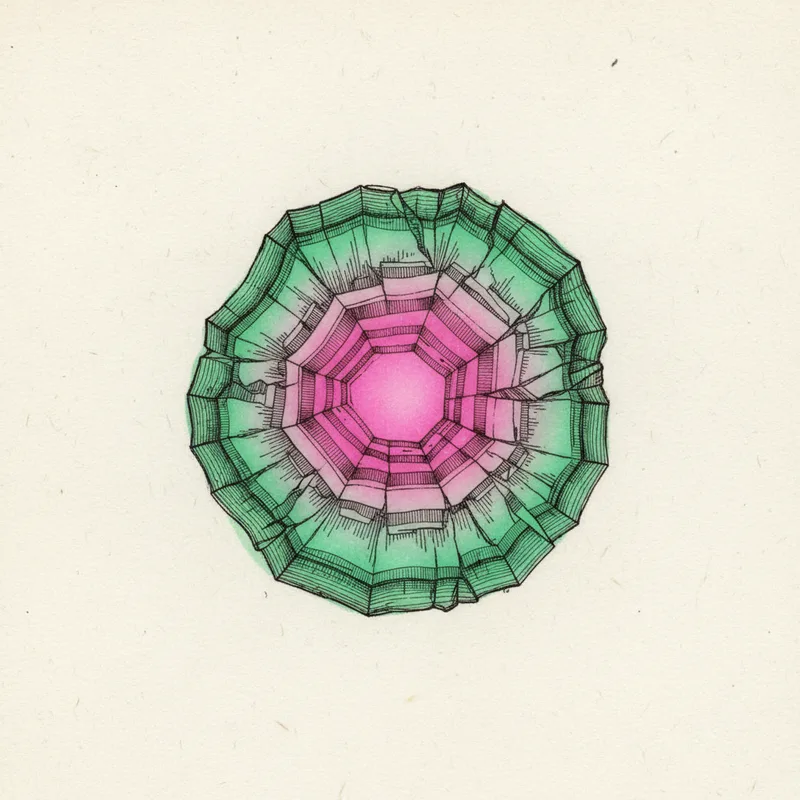
What you'll see in real tourmaline: Needle-like inclusions, sometimes called "silk." Growth tubes that run parallel to the crystal's length. Color zoning, where bands or areas of different color intensity reflect the crystal's growth history. Tiny mineral crystals trapped inside. Small fractures with a slightly irregular, natural appearance. In watermelon tourmaline, you'll see gradual color transitions between the pink core and green rim, not sharp lines.
What you'll see in glass fakes: Round bubbles. This is the single biggest giveaway. Natural tourmaline forms under conditions that produce elongated inclusions, not spherical air pockets. If you see perfectly round bubbles, it's glass. Period. You might also see swirl marks from the glass manufacturing process and perfectly uniform color with no zoning.
What you'll see in dyed stones: Color concentrated in cracks and fractures. The dye pools in surface-reaching fractures, making them appear darker than the surrounding material. If the cracks are conspicuously darker than the body of the stone, it's been dyed.
A 10x loupe costs $10-20 and is the single most useful tool you can own for evaluating any gemstone or crystal. It catches the majority of fakes across all mineral types.
5. Crystal Shape and Striations
This test applies to rough tourmaline, semi-polished points, and specimens that still show their original crystal faces (it won't work on fully faceted cut stones). When you can see the crystal shape, it's diagnostic on its own.
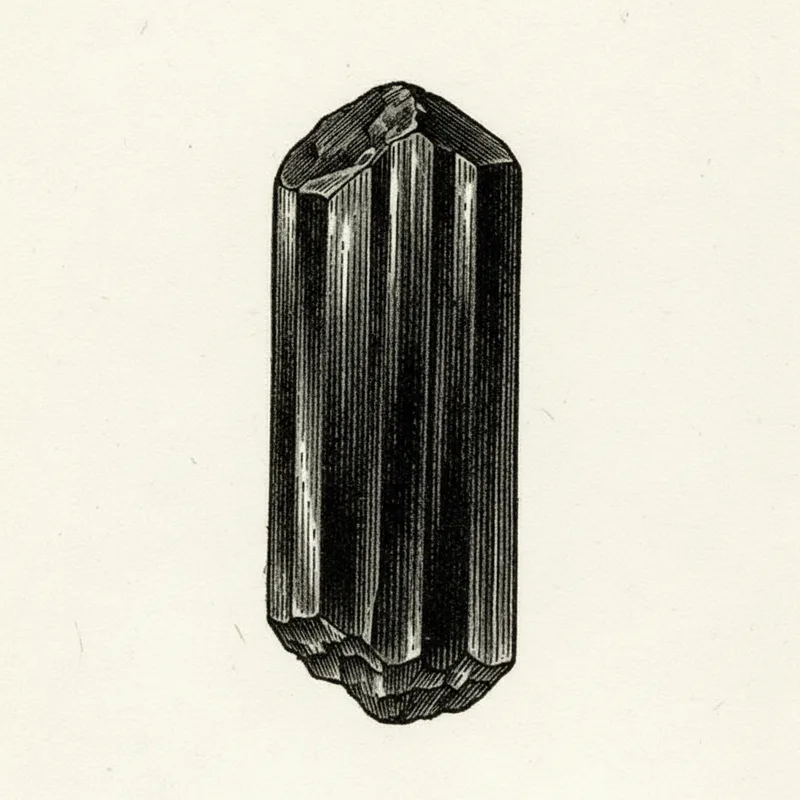
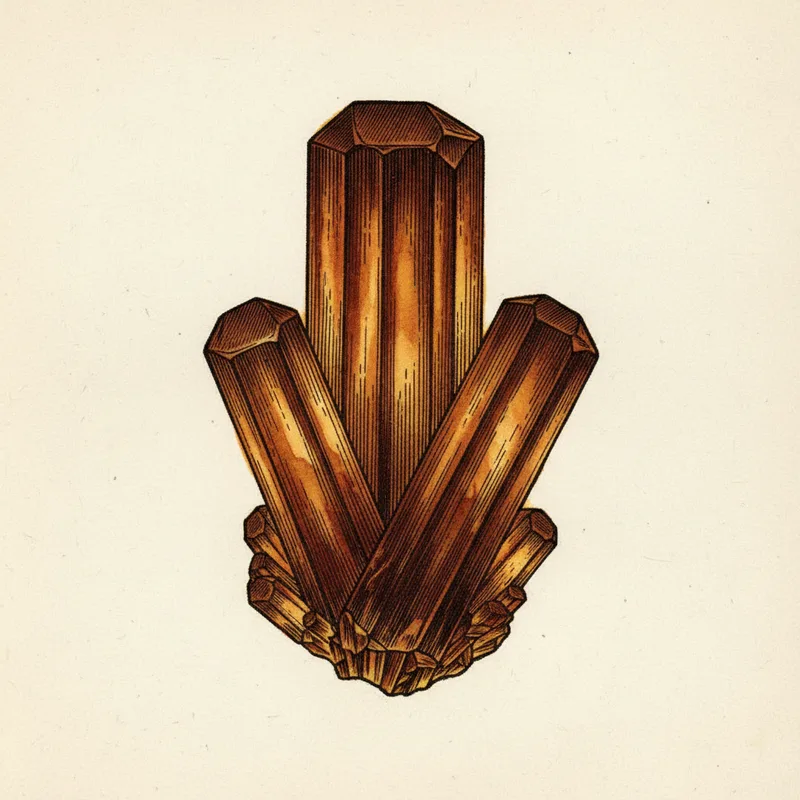
Tourmaline grows as elongated prisms with a rounded triangular cross-section, sometimes called a spherical triangle. It bulges outward along three sides and terminates with a pyramidal or flat end. No other common gem mineral grows in this shape. Quartz is hexagonal (six sides). Beryl is hexagonal. Topaz is orthorhombic with flat rectangular sides. Fluorite grows as cubes or octahedrons. If a rough "tourmaline" has a round, square, hexagonal, or irregular cross-section, it is not tourmaline.
The sides of the prism carry heavy vertical striations: fine parallel grooves running the full length of the crystal. These are growth features of the trigonal crystal system and they are deep, evenly spaced, and unmistakable. Run a fingernail across the prism face perpendicular to the long axis and you can feel the ridges.
No glass imitation reproduces this convincingly. Molded glass "tourmaline" rods are either smooth extruded cylinders or have faint fake striations that run irregularly and don't align with any crystal face. Plastic fakes are usually smooth or show mold seams. If you're holding a piece of rough with a bulging three-sided prism and deep vertical striations, you're almost certainly looking at real tourmaline regardless of color.
6. The UV Fluorescence Test
Put your tourmaline under a long-wave UV light (a blacklight, around $10-15) and observe what happens.
Most natural tourmaline is inert under UV light, meaning it shows no fluorescence. Some pink and red tourmalines fluoresce weakly in reddish or pinkish tones. Elbaite varieties occasionally show a faint response.
Glass fakes often fluoresce more strongly and in different colors than natural tourmaline, particularly greenish or chalky white. Synthetic materials and resins used in reconstituted "tourmaline" beads may fluoresce brightly under UV.
This test alone is not conclusive because UV response varies between specimens. But combined with other tests, an unexpected strong fluorescence is a warning sign. If your "black tourmaline" glows brightly under UV, something is wrong.
7. The Specific Gravity Test
Tourmaline has a specific gravity of approximately 3.00 to 3.25, depending on the species. Schorl (black tourmaline) sits around 3.10-3.20. Elbaite ranges from 3.00 to 3.10. Dravite is around 3.03-3.10.
Glass has a specific gravity of roughly 2.3-2.5. Plastic is even lighter at 1.0-1.5. This means that for the same size, tourmaline should feel noticeably heavier than glass, and dramatically heavier than plastic.
For a rough field test, simply hold the stone and gauge whether the weight matches the size. Real tourmaline feels dense and substantial. A piece of glass the same size will feel lighter. Plastic feels absurdly light in comparison.
For precise measurement, you can do a hydrostatic weighing test. Weigh the stone dry, then weigh it suspended in water, and calculate the specific gravity from the difference. If the result is well outside the 3.00-3.25 range, the stone is not tourmaline.
8. The Refractive Index Test
If you have access to a refractometer (common in gemological labs and some jewelry stores), tourmaline's refractive index provides a definitive identification. Tourmaline's RI ranges from 1.624 to 1.644 with a birefringence of 0.018-0.040. Glass typically reads around 1.50-1.52.
This is a conclusive test, but it requires equipment most casual buyers don't own. If you're evaluating a stone worth several hundred dollars or more, asking a local jeweler to check the RI takes about thirty seconds and removes all doubt.
9. The Electrical Test (Pyroelectricity)
Tourmaline has a genuinely unusual property: it's pyroelectric and piezoelectric. When heated or squeezed, tourmaline crystals develop an electrical charge on their ends. The Dutch used to call it "aschentrekker" (ash puller) because a heated tourmaline crystal would attract ash and dust particles.
You can test this at home. Warm the stone gently with a hair dryer for about 30 seconds, then hold it near small bits of torn tissue paper or dust. A genuine tourmaline crystal will attract the paper fragments due to the static charge it develops. Glass and plastic will not exhibit this behavior.
This test works best with elongated crystal specimens and is less reliable with tumbled stones or heavily polished cabochons, since the piezoelectric effect depends on the crystal structure being intact and the crystal having distinct terminations.
Common Tourmaline Fakes and How to Spot Each One
Dyed Glass
The most common fake across all tourmaline varieties. Glass is cheap, easy to color, and can be molded into any shape. Catch it with: magnification (bubbles), hardness test (won't scratch glass), pleochroism test (none), and weight (lighter than tourmaline). Glass is the easiest fake to identify because it fails nearly every test.
Dyed Quartz
Quartz has the same hardness as tourmaline (7), so the scratch test alone won't distinguish them. However, dyed quartz shows dye pooling in fractures under magnification, shows no pleochroism, and has a lower specific gravity (2.65 vs 3.00+). The weight difference is noticeable when comparing similar-sized pieces.
Synthetic Tourmaline
True synthetic tourmaline (grown in a lab with the same chemical composition) is extremely rare in the commercial market because tourmaline's chemical complexity makes it very difficult and expensive to synthesize. Most "synthetic tourmaline" for sale is actually synthetic spinel or glass labeled as tourmaline. If a seller claims lab-grown tourmaline at a low price, it's almost certainly something else entirely.
Plastic and Resin
The easiest fakes to spot. Plastic fails the temperature test (feels warm immediately), the hardness test (easily scratched), and the weight test (far too light). Under magnification, you may see manufacturing textures, mold seams, or trapped air in patterns inconsistent with natural crystal growth. A hot needle test works too. Touch a heated needle to an inconspicuous spot. Plastic melts or gives off a chemical smell. Real tourmaline is completely unaffected.
Reconstituted "Tourmaline" Beads
Ground-up tourmaline powder or other minerals mixed with resin and pressed into bead shapes. These are particularly common in multicolor "tourmaline" bead strands at suspiciously low prices. Under magnification, reconstituted beads show a granular, uniform texture without the directional growth features of natural tourmaline. They may also fluoresce strongly under UV due to the resin binder.
Black Tourmaline: The Most Faked Variety
Black tourmaline (schorl) deserves its own section because it's the most commonly faked tourmaline variety by volume, and several of the standard tests are harder to apply to opaque black stones.
Here's what works specifically for black tourmaline:
Hardness. Genuine schorl is 7-7.5. It easily scratches glass and cannot be scratched by a steel knife. Many black tourmaline fakes are dyed glass, ceramic, or plastic, all of which fail this test.
Surface texture. Natural black tourmaline typically shows vertical striations, fine parallel grooves running along the length of the crystal. These striations are a growth feature of the trigonal crystal system. If the surface is perfectly smooth with no directional texture (especially on raw specimens), be cautious.
Fracture pattern. Break a small piece (if the specimen is large enough and you don't mind). Real black tourmaline shows an uneven to conchoidal fracture with a slightly resinous to vitreous luster on freshly broken surfaces. Glass shows a smooth, shell-like conchoidal fracture. The difference is visible to the naked eye.
Weight. Black tourmaline has a specific gravity around 3.10-3.20. It should feel noticeably heavy for its size. Glass is lighter (SG 2.3-2.5), and plastic is dramatically lighter.
The hot needle test. On an inconspicuous spot, briefly touch a heated needle to the surface. Black plastic fakes melt or soften. Dyed resin pieces give off a chemical smell. Real tourmaline does nothing.
Streak test. Rub the stone on an unglazed porcelain tile. Real black tourmaline leaves no streak (it's too hard for the tile). Glass will leave no streak either, but soft black stones like jet (hardness 2.5-4) or black onyx substitutes will leave marks.
Paraiba Tourmaline: Where the Highest-Stakes Fraud Happens
Paraiba tourmaline is the single most valuable variety of tourmaline. Fine specimens of copper-bearing elbaite from the original Brazilian locality sell for $10,000 to $50,000+ per carat. That price tag creates enormous incentive for fraud.
Common Paraiba fakes include:
Coated topaz. White topaz coated with a thin layer of blue-green material. Under magnification, you can see coating wear at edges and facet junctions. The coating may show scratches that reveal a colorless layer beneath.
Apatite. Paraiba-colored apatite from Madagascar can look remarkably similar, but apatite is dramatically softer (hardness 5) and has a lower refractive index. A scratch test and RI reading separate them instantly.
Synthetic spinel. Lab-created spinel in Paraiba-like colors is common. It lacks pleochroism entirely, has a different RI (1.727 single refractive vs tourmaline's double refraction), and shows no copper content on chemical analysis.
Heated or treated tourmaline. Some lower-grade tourmaline is heated or irradiated to shift its color toward the prized neon blue-green. This is technically still tourmaline, but undisclosed treatment at Paraiba prices is fraud.
For any Paraiba tourmaline purchase above a few hundred dollars, a lab report from GIA, AGL, Gubelin, or SSEF is non-negotiable. The report should confirm the stone is natural tourmaline, copper-bearing, and ideally identify geographic origin. The cost of the report ($75-200) is trivial compared to the value difference between genuine Paraiba and a coated topaz.
"Tourmaline-Infused" EMF Products: Not Quite Fakes, Not Quite Crystals
A whole category of jewelry and wellness gadgets is sold as "tourmaline-infused," "negative ion," or "far-infrared EMF protection." This includes bracelets, knee sleeves, straightening irons, ceramic insoles, and water bottles. The marketing implies you're getting the pyroelectric properties of real tourmaline.
You're not, and the manufacturers aren't technically lying. These products contain genuine tourmaline powder mixed into a ceramic, plastic, silicone, or resin matrix. The powder is real. The product is not a crystal specimen. A pulverized mineral in a binder loses the coherent crystal lattice that produces pyroelectricity in a whole crystal. The composite will not attract dust when warmed. It won't show pleochroism. It fails every test in this article, not because it's a fake, but because it's not attempting to be a tourmaline crystal in the first place.
If you want the actual mineral for a collection, altar, or crystal grid, buy a labeled schorl or black tourmaline specimen from a mineral dealer. Expect to pay $5-40 for a decent rough point or cluster. An "EMF bracelet" with tourmaline powder in it can be a perfectly fine piece of jewelry, but it will not do anything a whole tourmaline crystal does.
The Species Factor: Not All Tourmaline Is Created Equal
Tourmaline is actually a mineral group containing multiple species. The main ones you'll encounter are:
- Schorl: Iron-rich, black. The most abundant tourmaline species, making up roughly 95% of all tourmaline found in nature.
- Elbaite: Lithium-rich, the species that produces most gem-quality colored tourmaline. Pink, green, blue, watermelon, and Paraiba varieties are all elbaite.
- Dravite: Magnesium-rich, typically brown to yellowish-brown. Increasingly popular as a collector stone.
- Liddicoatite: Calcium-rich, known for spectacular triangular cross-section color zoning.
These species differ slightly in specific gravity, refractive index, and inclusion types. A gemological lab can distinguish between them using chemical analysis (often EDXRF or LA-ICP-MS). For most buyers this level of detail only matters for high-value Paraiba and rubellite purchases where species identification affects value.
Quick Reference: Testing Tourmaline at a Glance
| Test | Real Tourmaline | Glass Fake | Dyed Quartz | Plastic |
|---|---|---|---|---|
| Pleochroism | Strong color shift | None | None | None |
| Hardness | 7-7.5, scratches glass | ~5.5, doesn't scratch glass | 7, scratches glass | 1-3, easily scratched |
| Crystal shape (rough) | Rounded triangular prism with striations | Smooth, no crystal faces | Hexagonal (quartz shape) | Smooth, mold seams |
| Temperature | Feels cool | Cool then warms fast | Feels cool | Feels warm |
| Magnification | Needles, tubes, zoning | Round bubbles, swirls | Dye pooling in cracks | Mold seams, uniform |
| UV fluorescence | Usually inert | Variable, often bright | Variable | Often bright |
| Specific gravity | 3.00-3.25 | 2.3-2.5 | 2.65 | 1.0-1.5 |
| Pyroelectricity | Attracts dust when heated | None | None | None |
When to Walk Away (and When to Pay for a Lab Report)
For casual purchases under $50, the pleochroism test, hardness test, and a quick look under magnification will catch the vast majority of fakes. If all three tests pass, you can buy with reasonable confidence.
For purchases between $50 and $500, add the specific gravity and UV tests. Ask the seller about treatments and origin. A reputable dealer will welcome these questions.
For anything over $500, or for any stone sold as Paraiba, rubellite, or chrome tourmaline, get a gemological lab report. The testing covered in our guide to identifying fakes applies broadly, but high-value tourmaline requires professional verification. The cost of a lab report is always worth it when the alternative is paying thousands for a $20 coated topaz.
FAQ
Can tourmaline be lab-created? Technically yes, but commercially it's almost nonexistent. Tourmaline's extreme chemical complexity (it contains boron, lithium, aluminum, silicon, sodium, and hydroxyl groups in a single structure) makes synthesis very expensive and impractical. If someone is selling "lab-created tourmaline" at a low price, it's almost certainly synthetic spinel, glass, or some other material entirely.
Is heat-treated tourmaline considered fake? No. Heat treatment to improve color is a standard, widely accepted practice in the gem trade when disclosed. Many green and blue tourmalines are routinely heated to lighten dark tones or improve saturation. The issue is when treatment goes undisclosed, or when treated stones are priced as untreated.
My tourmaline bead strand has lots of different colors. Is that normal? Multi-color tourmaline bead strands are legitimate. Tourmaline naturally occurs in an enormous range of colors, and bead makers often combine different-colored rough into a single strand. However, extremely vivid, uniform colors across the strand, or suspiciously low prices (under $10-15 for a full strand), suggest dyed quartz or reconstituted material rather than natural tourmaline.
Does real tourmaline have a static charge? Yes. Tourmaline is both pyroelectric (develops charge when heated) and piezoelectric (develops charge when compressed). This is a real, measurable physical property caused by its crystal structure. If your crystal picks up small paper fragments after being warmed, that's a strong positive indicator.
How can I tell watermelon tourmaline from a fake? Genuine watermelon tourmaline shows a gradual, natural color transition from pink center to green outer zone. Under magnification, the color zones follow the crystal's internal growth structure, with slightly irregular boundaries. Fake watermelon tourmaline (usually layered glass) shows sharp, perfectly straight color boundaries with no growth features. The pleochroism test also works: rotate the slice and look for subtle color shifts that glass won't display.
Authentication Guides for Other Stones
If you came here looking for help authenticating other commonly faked crystals, the /fakes hub covers the 10 most-faked stones with mineral-specific tests. For deep-dive checklists on individual stones:
- Is My Moldavite Real? 6 Tests Geologists Use - the lechatelierite wire check that separates real from molded glass
- Is My Amethyst Real? 5 Tests for Glass and Synthetic Fakes - color zoning, bubbles, and the synthetic-amethyst problem
- Is My Turquoise Real? - the acetone swab test that catches dyed howlite in seconds
Crystals in This Article
Watermelon Tourmaline
The Dual Heart Stone
Black Tourmaline
The Shield Stone
Tourmaline
The Rainbow Stone
Black Onyx
The Stone of Strength
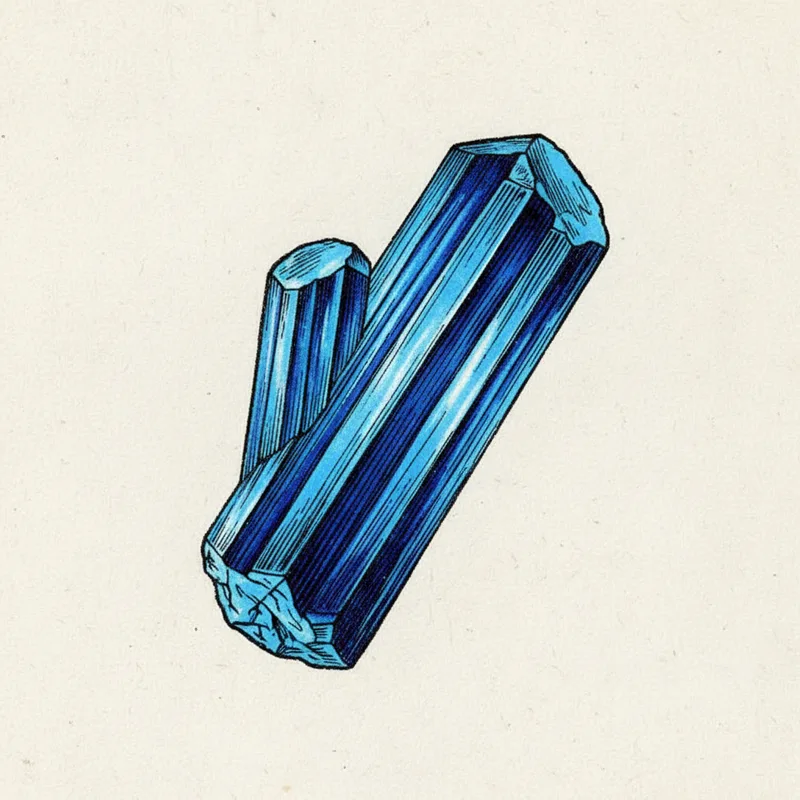
Indicolite
The Blue Tourmaline
Turquoise
The Sky Stone
Moldavite
The Stone from the Stars
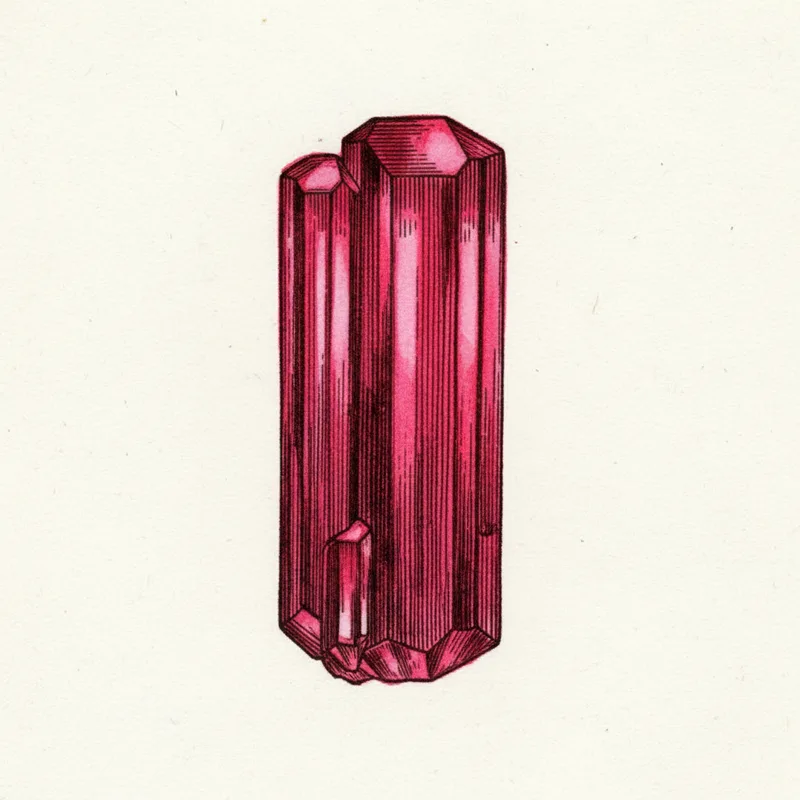
Rubellite
The Red Tourmaline Royalty
Amethyst
The Stone of Spiritual Wisdom
Fluorite
The Genius Stone
Howlite
The Calming Stone
Diamond
The Invincible
Keep Reading
Stay in the loop
From the Almanac
Updates from Crystal Almanac, when there’s something worth sharing.