Quick Facts
Formation & Origin
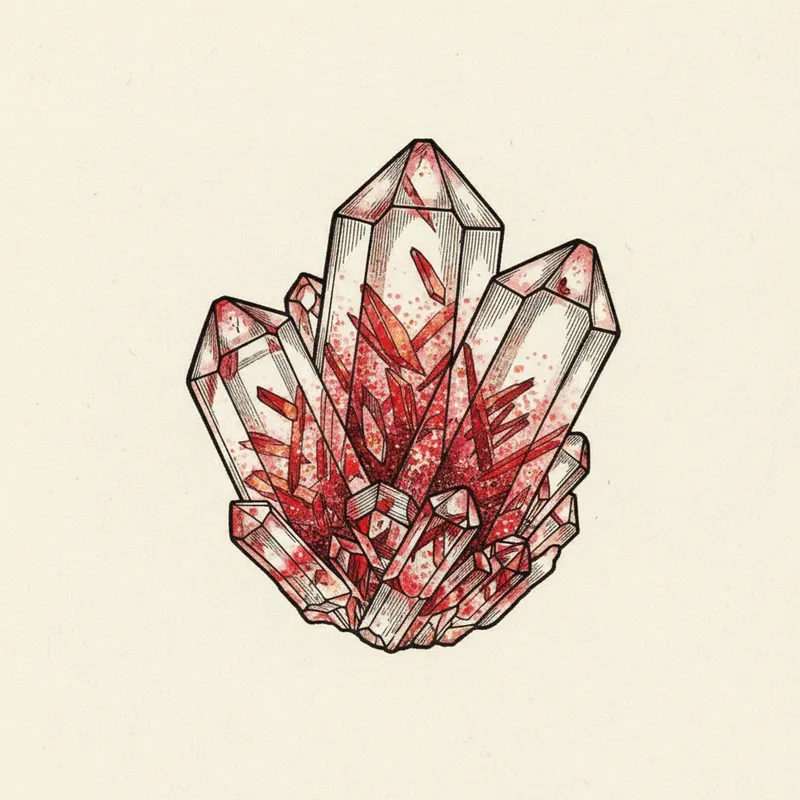
Harlequin Quartz forms when iron-oxide or iron oxyhydroxide platelets precipitate synchronously with quartz in hydrothermal veins and pegmatite pockets. As the quartz host slowly grew, plates of hematite (Fe₂O₃) or lepidocrocite (γ-FeO(OH)) nucleated and grew in parallel orientation within the silica melt, becoming permanently encased as the quartz continued to crystallize around them. The specific iron compound depends on the redox state of the mineralizing fluid: more oxidizing conditions favor hematite, while slightly more reducing, water-rich conditions favor lepidocrocite.
Madagascar specimens from Antsiranana Province typically show brilliant, near-vermilion red lepidocrocite platelets that catch light with theatrical sparkle. Brazilian specimens from Minas Gerais tend toward darker, more russet hematite flakes, frequently hosted in smoky rather than clear quartz. The name "harlequin" refers to the bright red flashes catching light from different angles as the stone is rotated. The platelets are oriented in crystallographically preferred directions, so they reflect light like tiny mirrors, producing a scattered constellation of red sparks rather than a uniform color.
Harlequin Quartz is distinct from the broader Fire Quartz category. Fire Quartz contains iron oxide in many forms, including cloudy flame patterns, diffuse orange-red zones, and hematite coatings on surfaces. Harlequin Quartz specifically refers to the variety with crystalline platelet inclusions that catch light like tiny mirrors. The distinction matters for collectors: a stone can be Fire Quartz without being Harlequin, but true Harlequin Quartz is always also technically Fire Quartz.
Identification Guide
Harlequin Quartz is identified by three features seen together: a clear or smoky quartz host, discrete platelet-shaped red inclusions rather than cloudy zones, and visible sparkle when the stone is rotated under a direct light source. Platelets should vary in size and have a somewhat random three-dimensional distribution inside the crystal. At hardness 7, the quartz host resists scratching by steel. Specific gravity near 2.65 matches standard quartz. Under a 10x loupe, individual platelets show hexagonal or lath-shaped outlines typical of hematite and lepidocrocite crystals.
Lepidocrocite platelets tend to be brighter, more saturated red and more translucent than hematite. Hematite platelets are darker, more metallic, and may show a slight purple-gray sheen at certain angles. Both are genuine and both qualify the specimen as Harlequin Quartz. The host quartz should show normal quartz features: conchoidal fracture on chipped surfaces, occasional growth phantoms, and temperature that feels cool to the touch (glass warms faster).
Spotting Fakes
Assembled doublets are the most common fraud: two pieces of clear quartz or glass sandwiched with a metallic glitter layer between them. Look carefully at the girdle (the edge) under a 10x loupe for a glue line or color discontinuity. Genuine Harlequin Quartz has platelets fully enclosed in the quartz matrix at varied depths, not concentrated on a single plane. Goldstone (copper-glitter glass) is sometimes sold as Harlequin Quartz or "red sparkle quartz." Goldstone shows perfectly uniform, ordered flake size and spacing because it is manufactured. It also has a warmer, more coppery tone and a distinctly glassy feel (no natural quartz imperfections). A shortwave UV light will often show goldstone with a faint uniform response, while natural hematite-bearing quartz is inert. Dyed or surface-coated quartz is another trap: stones painted or coated with red pigment to simulate internal platelets. Acetone on a cotton swab will dissolve most surface coatings within a few seconds. Genuine inclusions are untouched by acetone. Finally, some vendors sell bland iron-stained quartz with no discrete platelets as Harlequin. If there are no crisp reflective flashes as the stone rotates, it is not Harlequin Quartz regardless of label.
Cultural & Metaphysical Traditions
Presented as cultural traditions, not scientific evidence
Harlequin Quartz entered Western metaphysical circles in the early 2000s as Madagascar lepidocrocite-quartz became widely available. Practitioners describe it as a stone that combines the amplifying clarity of quartz with the grounding red energy of iron, framing it as a bridge between root-chakra vitality and heart-chakra courage. The harlequin name itself evokes the jester figure from commedia dell'arte, and some modern traditions associate the stone with playfulness, creative risk-taking, and shaking off stagnation. Older hematite-quartz specimens from the Urals were used in Russian folk jewelry as protective amulets against "evil eye," a tradition that survives in some Eastern European crystal shops today.
Where It's Found
Brilliant red lepidocrocite platelets, finest quality
Darker hematite flakes, often in smoky quartz host
Hematite-included quartz with copper-red flashes
Historically known hematite-quartz source
Price Guide
Good to Know
Scratch test: At hardness 7, Harlequin Quartz can scratch glass and steel. It's durable enough for any type of jewelry.
Sources: Found in 4 notable locations worldwide, from Madagascar to Kazakhstan.
Heft test: Harlequin Quartz has average mineral density (2.65). It feels about as heavy as you'd expect from a stone its size.
Related Minerals
Broader category; harlequin is the platelet-included subset
The iron oxyhydroxide producing bright red platelets
The iron oxide producing darker red-brown platelets
Quartz with needle inclusions instead of platelets
Explore More
Stay in the loop
From the Almanac
Updates from Crystal Almanac, when there’s something worth sharing.