Quick Facts
Formation & Origin
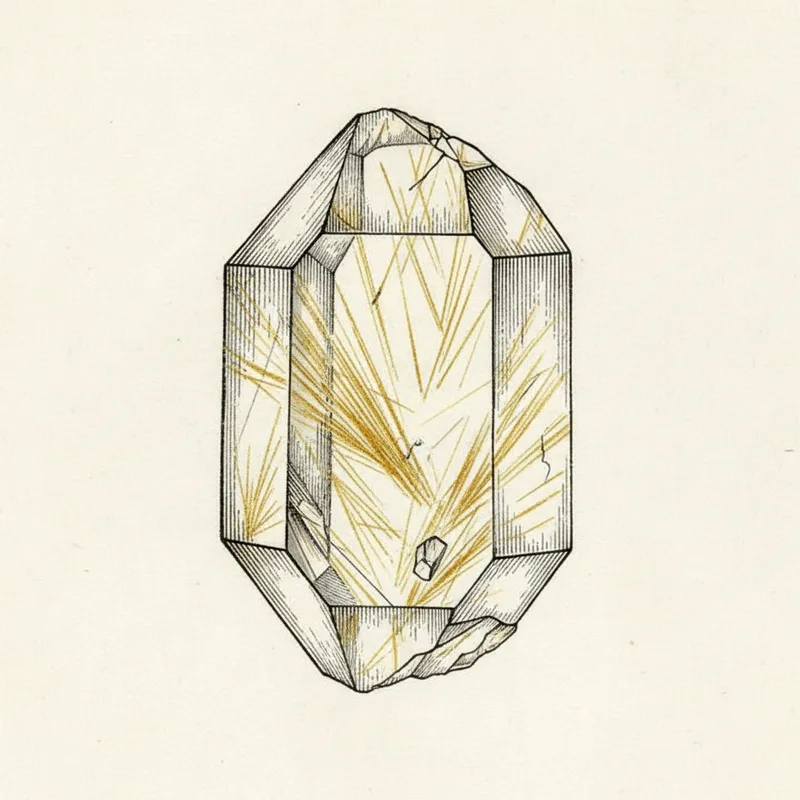
Rutilated quartz is clear or smoky quartz that contains needle-like crystals of rutile (titanium dioxide) trapped within it. The rutile crystallized first, and quartz later grew around it, permanently encapsulating the delicate rutile needles.
Rutile needles inside quartz can be golden yellow (the most common and sought-after), coppery red, silvery, or nearly black depending on iron content and crystal thickness. The needles range from fine hair-like threads to thick, brilliant bars. Some specimens contain dense networks of crossed or star-like rutile sprays, while others have just a few elegantly placed needles.
In gemology, inclusions generally reduce a stone's value. Rutilated quartz is one of the rare exceptions - here, the inclusions ARE the value. A clear quartz without rutile is worth very little; the same quartz with a dramatic spray of golden rutile needles becomes a sought-after collector's gem.
Identification Guide
Rutilated quartz is immediately identifiable by the visible needle-like inclusions within clear or smoky quartz. The needles are straight, metallic-looking, and often criss-cross at specific angles determined by rutile's crystal structure.
Distinguish from tourmalinated quartz (black tourmaline needles instead of metallic rutile), sagenite (various acicular mineral inclusions), and hair-like actinolite in quartz (green, not golden). The metallic golden color of rutile needles and their straight, geometric arrangement are diagnostic.
Spotting Fakes
Rutilated quartz is common enough and affordable enough that faking is rare. Glass with embedded metallic wires exists but is easy to spot - the 'needles' look too uniform and lack the natural randomness of real rutile. In genuine specimens, rutile needles taper at their ends and may show slight bends or intersections at crystallographically determined angles. Synthetically grown rutilated quartz doesn't exist commercially.
Cultural & Metaphysical Traditions
Presented as cultural traditions, not scientific evidence
Called 'Venus hair stone' since antiquity because the golden needles were thought to be strands of the goddess Venus's hair trapped in crystal. In Chinese tradition, rutilated quartz is popular for its association with wealth and prosperity - the golden needles represent streams of gold. Modern practitioners associate it with amplified intentions, accelerated manifestation, and illuminating hidden truths.
Where It's Found
World's primary source, exceptional quality
Good quality, both golden and dark rutile
Some fine specimens
Quartz with interesting rutile patterns
Price Guide
Good to Know
Scratch test: At hardness 7, Rutilated Quartz can scratch glass and steel. It's durable enough for any type of jewelry.
Sources: Found in 4 notable locations worldwide, from Brazil to Pakistan.
Heft test: Rutilated Quartz has average mineral density (2.65). It feels about as heavy as you'd expect from a stone its size.
Related Minerals
Similar concept, black tourmaline instead of rutile
The included mineral, titanium dioxide
Often hosts rutile inclusions
General term for acicular inclusions in minerals
Explore More
Stay in the loop
From the Almanac
Updates from Crystal Almanac, when there’s something worth sharing.