Is My Amethyst Real? 5 Tests for Glass and Synthetic Fakes
Key Takeaway: Amethyst is the most-purchased crystal in the U.S., which makes it a heavy target for two kinds of fakes: glass imitations (easy to spot) and lab-grown synthetic amethyst (chemically identical, harder to spot without gemological tools). Five tests separate real natural amethyst from both: color zoning, magnification for round bubbles, the temperature test, the hardness scratch test, and UV reaction. Synthetic amethyst is the trickier case and may require a lab opinion for high-value pieces.
Amethyst is the gateway crystal. It is the first stone most people buy, the most common gift in metaphysical shops, and the single most-searched mineral on Pinterest. That demand creates two distinct authentication problems: glass imitations sold to tourists and beginners, and lab-grown synthetic amethyst that is chemically identical to natural and increasingly hard to distinguish.
This post covers five practical tests for both. The first four catch all glass imitations. The fifth helps with synthetics, but synthetic amethyst at gemological grade can require lab equipment to definitively identify.
What Real Amethyst Is
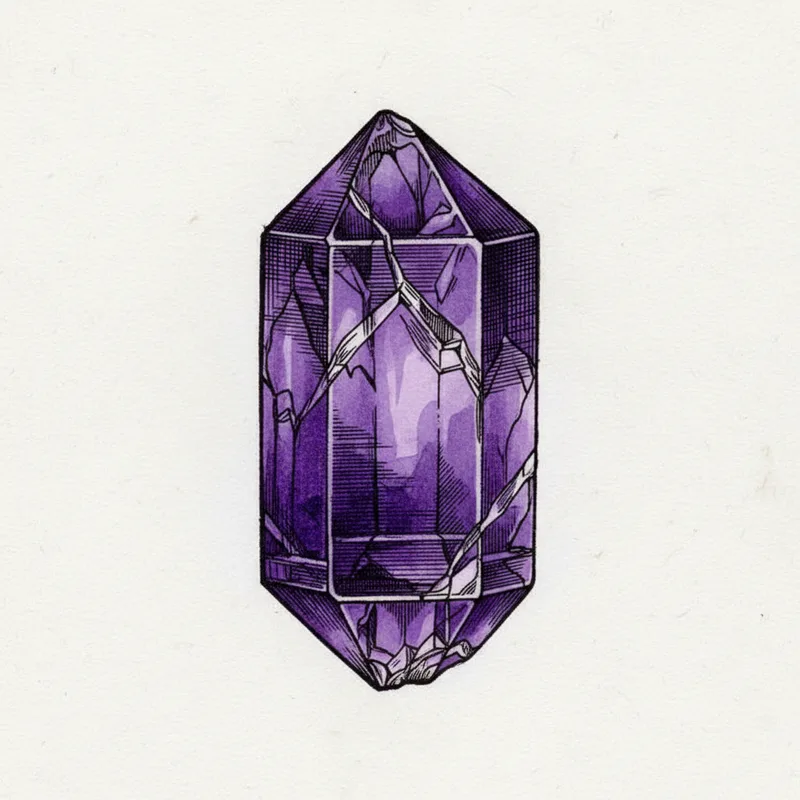
Amethyst is purple-colored quartz (silicon dioxide, SiO₂). The color comes from trace iron (Fe⁴⁺) in the crystal lattice combined with natural irradiation that displaces electrons and creates the color centers responsible for purple. The Mohs hardness is 7. The crystal system is trigonal. Specific gravity is 2.65.
Natural amethyst forms in volcanic geodes, hydrothermal veins, and pegmatites, with the largest commercial deposits in Brazil (Rio Grande do Sul), Uruguay (Artigas), Zambia, and Russia. Each locality has subtle differences in color, zoning pattern, and inclusion type that experienced collectors can identify by sight.
The fakes you will encounter:
- Glass dyed purple - cheap, easy to spot, common in tourist shops
- Dyed quartzite - lower-grade quartz dyed purple, sometimes sold as "amethyst"
- Lab-grown synthetic amethyst - real quartz, real purple color, but grown in a hydrothermal autoclave instead of in nature
The first two are obvious under the tests below. The third is the difficult case.
Test 1: Color Zoning (No Tools Required)
This is the single best test for natural versus synthetic, and it costs nothing.
Hold the amethyst up to a strong light source and rotate it slowly. Look for uneven distribution of color - bands, patches, or zones where the purple is darker in some areas and lighter or clear in others.
Real natural amethyst: Almost always shows color zoning. The purple typically follows the crystal faces or appears in irregular patches. Often there are clear or smoky zones at the base. Some specimens show dramatic color banding that follows the rhombohedral crystal faces.
Synthetic amethyst: Tends to be more uniform in color. The hydrothermal growth process produces a more even color distribution because the chemistry is consistent throughout the growth chamber. Some synthetics show "chevron" or zigzag growth patterns that differ from natural zoning.
Glass imitations: Completely uniform purple throughout, OR purple concentrated only in surface cracks (dyed). No internal structure.
If a stone shows zero zoning, no clear/smoky areas, and is uniformly deeply colored, it is either synthetic or glass. Run the next tests to figure out which.
Test 2: Bubble Test Under 10x Loupe
A 10x jeweler's loupe costs $10-15. You should own one if you buy crystals.
Look inside the stone (through it, not just at the surface) for trapped bubbles.
Glass imitations: Show perfectly round, spherical bubbles. Glass solidifies from a liquid melt, and the bubbles formed during cooling are uniform spheres. Count them - glass often has many.
Real amethyst (natural or synthetic): No round bubbles. May have angular or irregular inclusions, fluid inclusions (which look like flat planes with a small gas bubble inside), needle-like inclusions, or "color zoning seen edge-on" that looks like layers.
If you see round bubbles, it is glass. End of test. The only fakes that pass this test are dyed quartzite (no bubbles, but also no proper amethyst color or zoning) and synthetic amethyst (real quartz growth, so no bubbles).
Test 3: Temperature Feel
Pick the stone up. Real quartz (natural or synthetic) feels noticeably cool to the touch and stays cool for several seconds even when held in a warm hand. This is because quartz has high thermal conductivity and high heat capacity.
Glass warms up much faster. After 5-10 seconds in your hand, glass feels lukewarm. Quartz still feels cool.
This is not a definitive test (synthetic amethyst passes it just like natural), but it is fast and free. It catches glass imitations that somehow slipped past the bubble test.
Test 4: Mohs Hardness Scratch Test
Real quartz has a Mohs hardness of 7. Common glass is 5.5. Steel is 5.5-6.5.
The test: A steel knife or kitchen knife will not scratch real amethyst. Try it on the base or an inconspicuous surface. If the steel scratches the stone, it is glass (or a much softer dyed material, possibly fluorite or calcite sold as amethyst).
The reverse test: Real amethyst will scratch glass. Press a clean point or edge against an unwanted glass bottle. Real quartz leaves a visible scratch. Glass on glass produces no scratch.
Be careful with both versions of this test. You can damage a stone, and steel can leave metallic streaks that look like scratches but wipe off. Test in good light, and try to wipe the surface with a finger before declaring a scratch real.
This test catches all glass and almost all soft-mineral fakes. It does not separate natural from synthetic amethyst (both are real quartz at hardness 7).
Test 5: UV Reaction
Some amethyst fluoresces faintly under UV light, but the response is subtle and inconsistent. The more useful UV test catches dyed materials.
Shine a UV flashlight (365nm or longwave) on the stone in a dark room.
Real amethyst: Either no fluorescence, or a faint chalky white/blue-white glow. Some Brazilian amethyst shows weak greenish fluorescence.
Dyed glass or dyed quartzite: Often glows brightly in unnatural colors (vivid pink, orange, or saturated blue) because organic dyes fluoresce strongly under UV. If your "amethyst" lights up like a highlighter under UV, it is dyed.
Synthetic amethyst: Generally similar fluorescence to natural amethyst, so UV does not separate the two. This is why synthetics are the hardest case.
The Synthetic Amethyst Problem
If a piece passes Tests 1-4 but you still suspect it is synthetic, you have three options:
Accept the uncertainty. For pieces under $50-100, the difference in market value between natural and synthetic is small enough that lab testing is not worth it. Many crystal users do not care energetically whether the stone was grown in a Russian autoclave or a Brazilian geode.
Look at price and source. Natural Brazilian amethyst geodes, Uruguayan cathedrals, and Zambian deep-purple specimens are widely available at fair prices through reputable mineral dealers. If the seller knows the locality and the price is consistent with the market, you are very likely getting natural material. Synthetics are usually sold either as faceted gems (where they are clearly disclosed) or by sellers who mass-produce ambiguous "amethyst" jewelry.
Get a gemological certificate. For high-value pieces ($200+), labs like GIA can identify natural versus synthetic amethyst using techniques like FTIR spectroscopy, Brazil law twinning observation under polarized light, and inclusion analysis. This costs $50-150 and is worth it for serious purchases.
For most buyers, the decision tree is: did it pass the four practical tests? Yes? Buy from a seller who states the locality. Done.
Quick Reference: What Each Test Catches
| Test | Catches | Misses |
|---|---|---|
| Color zoning | Glass, most synthetics | High-end synthetics |
| Bubble loupe test | All glass | Synthetics, dyed quartzite |
| Temperature feel | Glass | Synthetics |
| Hardness scratch | All glass, soft fakes | Synthetics |
| UV reaction | Dyed glass, dyed quartzite | Synthetics |
If a piece passes all five, it is real natural quartz. To then separate natural amethyst from lab-grown amethyst, see option 3 above.
Where Most Amethyst Fakes Show Up
The pattern, based on what shows up at gem shows and complaints in collector forums:
- Tourist destinations sell glass imitations and dyed quartzite as "amethyst"
- Mass-market jewelry sometimes substitutes synthetic amethyst without disclosure
- Online auction platforms see flat-color "deep purple amethyst" listings that are usually glass or extremely dyed material
- Estate sales and antique stores can have older natural pieces, but also Victorian glass paste imitations that have aged
Buying from a reputable mineral dealer who knows their localities is the simplest defense.
Related Reading
- How to Spot Fake Crystals - the general authentication hub
- Crystal Authentication Field Guide - printable PDF for shop visits
- Is My Moldavite Real? - the 6-test moldavite checklist
- How to Tell If Your Crystal Is Real - the broader authentication primer
- Amethyst profile - full geological and metaphysical profile
- Crystals That Fade in Sunlight - amethyst is one of them
Crystals in This Article
Keep Reading
Stay in the loop
From the Almanac
Updates from Crystal Almanac, when there’s something worth sharing.