Is My Moldavite Real? 6 Tests Geologists Use
Key Takeaway: Real moldavite has two visual giveaways that are almost impossible to fake well: an "etched, pitted" matte surface that took millions of years of soil weathering to form, and a "wet, glassy" look only on truly polished pieces. The market is flooded with green bottle glass molded from real specimens and acid-etched to mimic the texture. Six tests separate genuine Czech moldavite from molded glass: surface texture, color, weight, magnification (for lechatelierite wires and bubble shape), price, and provenance.
You bought a piece of moldavite. Or someone gave you one. Or you saw one online for what feels like a suspiciously good price and you want to know whether to pull the trigger. This post is the checklist version.
If you want the longer comparison-format breakdown of moldavite versus green glass, see Moldavite vs Green Glass. This page is the practical version: six tests, in order, to run on a piece you can hold or examine in detail photos.
Why Moldavite Gets Faked So Heavily
Moldavite is a tektite, a natural glass formed when a meteorite struck what is now southern Germany roughly 14.7 million years ago. The impact melted local rock, blasted it into the upper atmosphere, and rained molten droplets across an area that is now in the Czech Republic. There is no other source. There never has been.
That single source produces a finite supply, and after a viral surge in interest around 2020-2022, prices climbed from a few dollars per gram to $20-$100+ per gram for quality pieces. Larger museum-grade specimens can run $200-300 per gram or more. That price pressure created an enormous incentive for fakes.
The most common fakes are made from green bottle glass, melted, pressed into silicone molds cast from real moldavite, then surface-treated with hydrofluoric acid to mimic the pitted texture. Done well, they fool beginners. Done with the six tests below, they almost never fool anyone.
The Two Dead Giveaways
Before walking through the full checklist, there are two phrases that come up over and over in collector communities (especially on r/Moldavite and r/Crystals): "etched pitted surface" and "wet glassy look." Learn to see both.
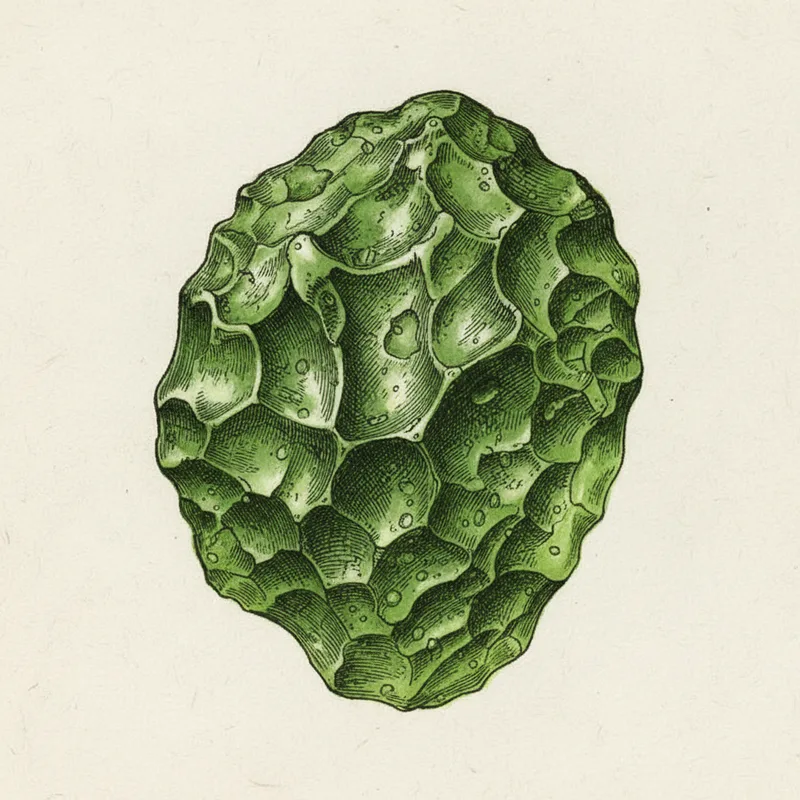
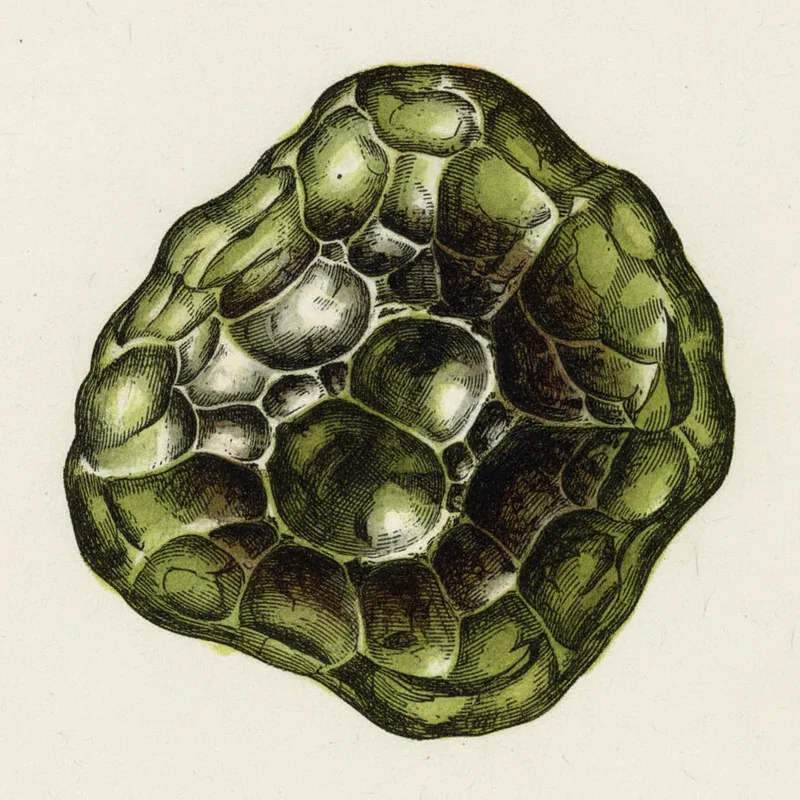
Etched, pitted surface. Real moldavite has a matte, complex, irregular surface texture covered in micro-pits, wrinkles, lechatelierite ridges, and what collectors call "navrcholový" sculpting. This pattern is the result of 14 million years of acidic groundwater slowly etching the glass. It does not look uniform. It does not look smooth. Hold a real piece next to a fake under raking light and the difference is obvious.
Wet, glassy look. This is the giveaway for the opposite end of the spectrum: pieces that are too smooth, too shiny, look like they were just dipped in water. That look is what melted bottle glass produces straight out of the mold, before any surface treatment. If a fake is poorly made, it skips the acid-etch step and arrives looking wet and glassy. If you see that look on a stone sold as moldavite, walk away.
Now the six tests, in order from cheapest to most demanding.
Test 1: Surface Texture (No Tools Required)
Look at the piece in good light, then tilt it. Real moldavite has irregular pitting, ridges, and "wrinkles" that flow in different directions across different parts of the stone. The texture is chaotic and organic.
Fakes show one of two patterns:
- Smooth and shiny (un-etched bottle glass)
- Texture that looks identical on multiple specimens from the same seller (mold replication)
If you are buying online and a seller posts photos of three "different" moldavites where the pits and ridges line up exactly, those are pulled from the same mold. Real moldavite is unique on every piece, like fingerprints.
Test 2: Color (Look Through It)
Hold the piece up to a strong light source.
Real moldavite color range: olive green, forest green, brownish-green, sometimes with internal variation between zones. The green is moody and earthy, never "bottle Kelly green."
Fake color range: bright bottle green, vivid emerald, uniformly saturated. Glass made from beverage bottles takes on a vibrant green that real moldavite essentially never shows.
Note: there is a rare moldavite variety from the Chlum locality that can be slightly more vibrant green, but it is also more expensive and usually traded with documented provenance. If a piece is bright green AND cheap, that combination is almost always a fake.
Test 3: Weight and Feel
Real moldavite has a specific gravity of about 2.35, lower than ordinary quartz (2.65) and lower than soda-lime glass (~2.5). It feels lighter than you expect when you pick it up.
This is hard to use as a standalone test (you need a comparison piece) but it works as a tiebreaker. If you have an unknown piece next to a known real one of similar size, the unknown should feel about the same weight. If it feels noticeably heavier and looks too smooth, you are probably holding bottle glass.
Test 4: Magnification (10x Loupe Required)
This is the test that catches the most fakes. A 10x or 20x jeweler's loupe costs $10-15 and pays for itself the first time you use it.
Look inside the stone. You are looking for two things:
Lechatelierite inclusions. These are squiggly, hair-like or wire-like inclusions of pure melted quartz trapped inside the moldavite glass when it solidified mid-flight. They look like white or clear filaments, often curved or twisted. Manufactured glass cannot reproduce them.
Bubble shape. Real moldavite bubbles are elongated, torpedo-shaped, sometimes flattened or distorted by the aerodynamic forces during flight. Manufactured glass bubbles are perfectly round and spherical, because nothing was deforming them during solidification.
If you see lechatelierite wires, you almost certainly have real moldavite. If you see only round bubbles and no wires, you almost certainly have glass.
Test 5: Price Reality Check
Real moldavite has a market floor that has held steady for years.
Approximate price ranges (2026):
- Small chips and tumbled fragments: $15-25 per gram
- Small to medium quality pieces (1-3g): $25-50 per gram
- Larger high-quality pieces (5-10g): $50-100 per gram
- Museum-grade or rare locality pieces: $100-300+ per gram
Anything sold dramatically below the lower end of this range, especially in larger sizes, is almost certainly fake. A "10-gram moldavite pendant" for $15 is mathematically impossible at real-market prices. The math does not work even before profit.
This test alone catches a huge fraction of online fakes, particularly on large e-commerce platforms where sellers list "moldavite" pieces at glass-bead prices.
Test 6: Provenance and Seller
Real moldavite comes from a small, well-documented region in the Czech Republic, primarily Bohemia (around the Vltava/Moldau river) and Moravia. Mining is regulated. Reputable dealers can trace specimens back to specific localities (Besednice, Chlum, Slavce, Radomilice, etc.).
Green flags:
- Dealer specializes in tektites or meteorites
- Stated locality (Besednice and Chlum are the most prized)
- Photos showing the piece from multiple angles, including macro detail of texture
- Clear return policy if you find issues
Red flags:
- Sold from China, Southeast Asia, or India with no provenance
- Dealer also sells dozens of other "rare" stones at suspicious prices
- "Lab-certified" with no accessible certificate or with a vague certificate
- Bulk listings ("100 pieces of moldavite") at flat prices
Provenance is the test that closes the loop. Even a piece that passes the first five tests should ideally come with some answer to "where in the Czech Republic did this come from?"
Putting It Together
If a stone passes all six tests, it is almost certainly real. If it fails on surface texture, color, OR magnification, it is almost certainly fake. The other three tests (weight, price, provenance) are tiebreakers when the first three are ambiguous.
Most fakes fail at magnification before anything else. If you only invest in one tool, get a 10x loupe. The lechatelierite test alone is more reliable than every other visual cue combined.
What If I Already Bought One That Failed?
If you bought from a reputable seller, return it. Most legitimate dealers will refund a piece you can demonstrate is fake, especially if you can show macro photos of round bubbles or molded texture matching another listing.
If you bought from a marketplace seller with no return policy, this is unfortunately the cost of the lesson. Keep the piece as a reference for what fake moldavite looks like up close. Then go buy a real one from a tektite dealer who can show you provenance.
Related Reading
- Moldavite vs Green Glass: How to Spot a Fake Tektite - the longer comparison breakdown
- How to Spot Fake Crystals - the general authentication hub covering 10 most-faked stones
- Crystal Authentication Field Guide - printable PDF for shop visits
- Most Faked Crystals on TikTok - the wider trend context
- Moldavite profile - full geological and metaphysical profile
Crystals in This Article
Keep Reading
Stay in the loop
From the Almanac
Updates from Crystal Almanac, when there’s something worth sharing.