The 10 Most Faked Crystals on TikTok (With Tests)
Key Takeaway: From baked amethyst sold as citrine to factory glass labeled "blue obsidian," these are the ten crystals most commonly misrepresented on TikTok and online marketplaces. Each section includes what the real mineral actually looks like, what the fakes get wrong, and specific at-home tests to tell them apart.
Crystal TikTok is a masterclass in beautiful lighting and questionable labeling. Scroll long enough and you'll see hauls of blazing orange "citrine" towers, neon turquoise slabs, and glowing blue orbs sold as obsidian. The colors are gorgeous. The mineralogy is fiction.
The crystal market has always had a faking problem, but social media supercharged it. When a stone trends, demand spikes overnight, and the supply chain fills the gap with dyed, heated, irradiated, or outright manufactured substitutes. Sellers aren't always being dishonest. Many genuinely don't know what they're selling. But your wallet doesn't care about intent.
We've already put together our complete guide to testing crystals, which covers universal methods like temperature checks, hardness testing, and UV fluorescence. This post is different. These are the ten stones that get faked the most, with mineral-specific tests tailored to each one. Think of it as a field guide to not getting ripped off.
1. Citrine
Citrine wins the crown for the most misrepresented crystal on Earth, and it's not close. Conservative estimates suggest that 90-95% of what's sold as citrine is actually amethyst that's been baked in a kiln.
Here's the geology. Both citrine and amethyst are varieties of quartz (SiO₂). Amethyst gets its purple from iron impurities and natural irradiation. When you heat amethyst to around 450-500°C, those same iron centers shift their oxidation state from Fe⁴⁺ to Fe³⁺, and the purple becomes orange. Laboratories and mass producers in Brazil have been doing this for decades because natural citrine is relatively uncommon, while amethyst is abundant and cheap.
What the fake looks like: Intense burnt orange, often with stark white bases. The color concentrates at the crystal tips and fades abruptly downward. Geodes labeled "citrine cathedral" with vivid orange crystals inside are the most common form. The color looks cooked because it was.
What real citrine looks like: Pale. Strikingly pale, compared to what TikTok has trained you to expect. Think champagne, straw yellow, or light honey. Natural citrine from Zambia or the Democratic Republic of Congo has an even, smoky-yellow tone throughout the crystal, with none of the burnt-tip effect.
How to test it:
- Examine the color distribution. If the orange pools at the tips and bleaches to white at the base, it's heat-treated amethyst. Real citrine colors the entire crystal relatively evenly.
- Look for burnt terminations. Heat treatment creates a harsh, almost caramelized gradient at the crystal points. Natural citrine transitions gently with no scorched appearance.
- Ask about origin. Genuine citrine comes primarily from Zambia, Madagascar, and the Congo. A seller offering deep orange "Brazilian citrine" is almost certainly selling heated amethyst.
2. Moldavite
Moldavite went from a niche collector's tektite to TikTok's hottest crystal almost overnight in 2020, and the counterfeit market scaled just as fast. Understanding why fakes fail requires understanding what moldavite actually is.
Roughly 14.7 million years ago, an asteroid roughly a kilometer wide slammed into what is now the Nordlinger Ries crater in southern Germany. The impact liquefied surface rock and launched molten glass across hundreds of kilometers. That glass solidified as it flew through the atmosphere and landed across southern Bohemia in the Czech Republic. That's moldavite. It is the only gem-quality material on Earth formed by a meteorite impact.
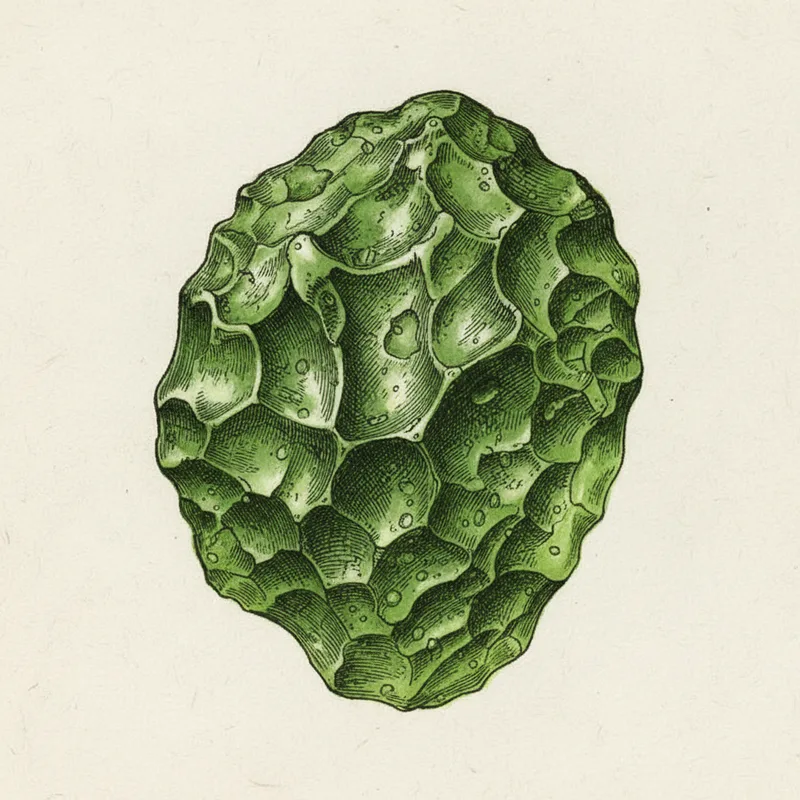
What the fake looks like: Smooth, bright green glass, often with perfectly round bubbles visible inside. Many counterfeits are cast from silicone molds taken from real specimens, so the overall shape might look plausible, but the surface is too clean. Some feel slightly tacky or have a uniform color that looks like a green bottle.
What real moldavite looks like: The surface is the giveaway. Genuine moldavite has deeply sculptured, wrinkled textures from atmospheric ablation during flight and millions of years of chemical weathering in Czech soils. The green ranges from olive to dark forest, rarely bright or vivid. Under magnification, real moldavite contains lechatelierite, threads of pure SiO₂ glass formed when the impact melted quartz grains at temperatures exceeding 1,700°C. These appear as elongated, worm-like inclusions, nothing like the round gas bubbles in manufactured glass.
How to test it:
- Study the surface texture. Real moldavite has deeply etched, almost brain-like surface patterns. Fakes are conspicuously smoother, even when they've been textured to imitate the real thing.
- Magnify the inclusions. At 10x, manufactured glass shows perfectly spherical bubbles. Real moldavite shows flowing, elongated lechatelierite threads and internal swirl structures.
- Gut-check the price. Genuine rough moldavite runs $15-30 per gram minimum as of 2026, with high-quality pieces much more. If you're finding polished pendants for $10-15, you're buying Czech-themed costume jewelry.
For the full six-test stone-in-hand checklist with the "etched pitted" and "wet glassy" phrasing collectors actually use, see Is My Moldavite Real?.
3. Turquoise
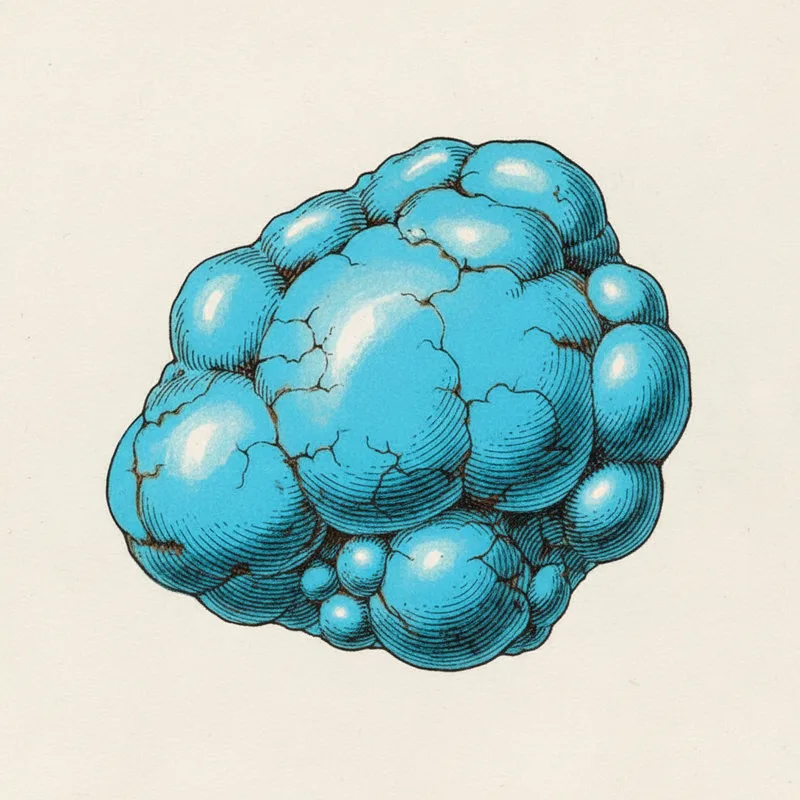
Turquoise (CuAl₆(PO₄)₄(OH)₈·4H₂O) has been counterfeited since the ancient Egyptians started prizing it, so at least the fakers have tradition on their side. The most common modern substitute is dyed howlite, a white calcium borosilicate mineral with gray veining that mimics turquoise matrix patterns once it's soaked in blue dye.
What the fake looks like: Dyed howlite turquoise tends to be too uniformly colored, with veining that looks just slightly too crisp and regular. It may also feel lighter in the hand than you'd expect, since howlite has a lower specific gravity (2.5-2.6) than turquoise (2.6-2.8). Reconstituted turquoise, real turquoise dust bonded with epoxy resin, is also widespread and harder to detect visually.
What real turquoise looks like: Natural turquoise varies from sky blue to green-blue depending on its copper-to-iron ratio (more copper means bluer, more iron means greener). The matrix is irregular brown or black host rock, not perfectly symmetrical web patterns. It has a waxy to subvitreous luster and feels satisfyingly dense.
How to test it:
- The acetone test. Dampen a cotton swab with pure acetone (nail polish remover without additives) and press it firmly against an inconspicuous area. If blue dye transfers to the cotton, you have dyed howlite.
- The hardness test. Real turquoise sits at 5-6 on the Mohs scale. Howlite is only 3.5. A copper coin (also about 3.5) won't scratch genuine turquoise but will leave a mark on howlite. Try it on the back or bottom of the piece.
- The weight comparison. Pick up the stone. Real turquoise is noticeably denser than howlite of similar size. If a large cabochon feels strangely light, that's a red flag.
For the full six-test checklist including the hot-needle plastic test and the stabilized-vs-natural disclosure question, see Is My Turquoise Real?.
4. Blue Obsidian
This one is simple. Approximately 95% of what's sold online as "blue obsidian" is manufactured cobalt glass. Full stop.
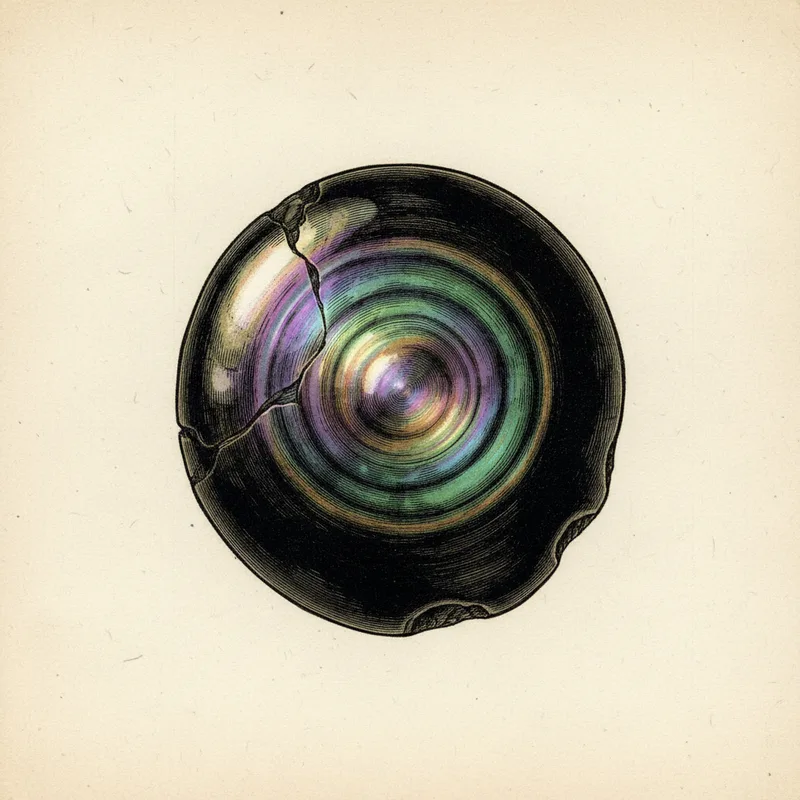
Obsidian is a volcanic glass that forms when felsic lava cools so rapidly that crystals don't have time to develop. It's typically black, sometimes with iridescent sheens from nanoscale inclusions of magnetite or hedenbergite. Genuinely blue obsidian does exist in very limited deposits in Greece and parts of Mexico, but it looks nothing like the vivid aqua spheres flooding TikTok.
What the fake looks like: Bright, uniform, translucent blue. Think blue Jolly Rancher candy. Sellers label it "blue obsidian," "aqua obsidian," or "sea blue obsidian." It's glass from a factory, not a volcano.
What real blue obsidian looks like: A subtle, directional blue sheen that appears only at certain lighting angles against an otherwise dark, mostly opaque body. It's closer in appearance to the soft color play on rainbow obsidian than to anything you'd describe as "bright blue." If you held it in one hand and a piece of regular black obsidian in the other, you might not notice the difference at first glance.
How to test it:
- The transparency check. If you can see clearly through it and it glows a uniform vivid blue, it's manufactured glass. Natural obsidian ranges from opaque to slightly translucent at thin edges, never see-through aqua.
- Magnify it. Manufactured glass contains tiny, perfectly spherical gas bubbles. Natural obsidian may have flow banding or microscopic crystalline inclusions, but not factory-perfect round bubbles.
- Apply common sense to the supply. If a seller has twenty identical bright blue spheres in stock at $10 each, they're selling a product that came from a glass factory, not a geological rarity.
5. Malachite
Malachite (Cu₂CO₃(OH)₂) forms when copper deposits interact with carbonated water and limestone over time, precipitating in concentric layers that create its famous green banding. That banding is both what makes malachite beautiful and what makes it surprisingly easy to fake with polymer clay.
What the fake looks like: The banding is too perfect. Stripes are evenly spaced, uniformly thick, and repeat with mechanical regularity. The greens may be too vivid or too uniform in tone. Some fakes use green-dyed resin or compressed stone powder bonded with epoxy. On TikTok, sculpted polymer clay "malachite" bowls and hearts appear with suspicious frequency.
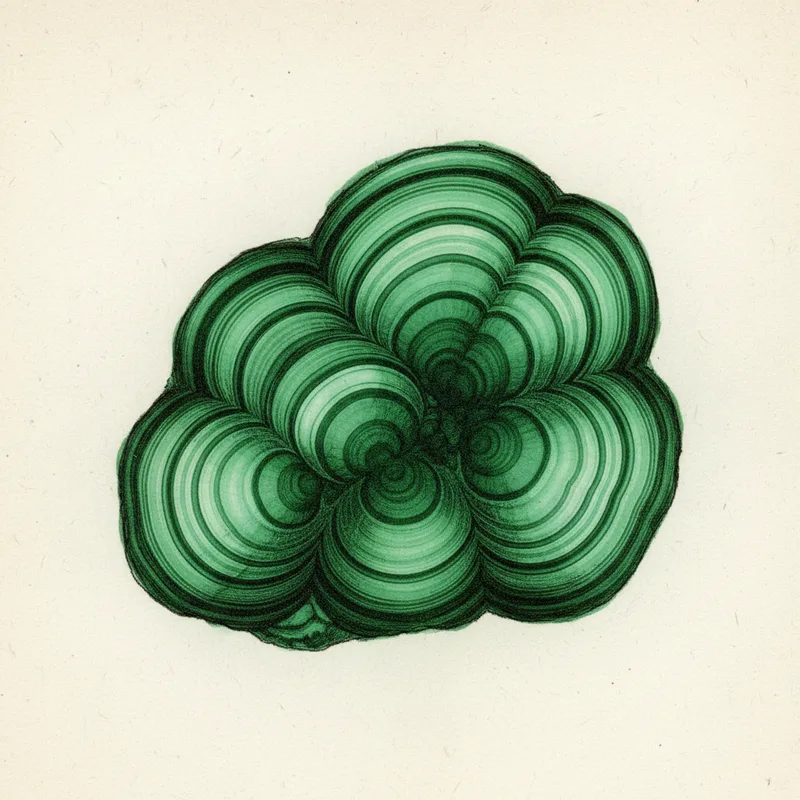
What real malachite looks like: Organic chaos. The banding curves, swirls, branches, and varies in thickness because it follows the botryoidal (grape-cluster) growth habit of the mineral. Colors range from nearly black-green to pale mint within the same piece. When polished, genuine malachite takes on a silky, almost satiny luster that polymer clay can't replicate.
How to test it:
- Analyze the banding pattern. If the stripes are parallel, evenly spaced, and mechanically regular, it's a fabrication. Real malachite banding undulates, pinches, splits, and reforms organically. No two sections look alike.
- The cold test. Real malachite is a dense copper carbonate mineral and feels distinctly cold to the touch. Polymer clay and resin reach skin temperature quickly and feel plasticky. Press it against your cheek for a quick thermal read.
- The weight test. Malachite has a specific gravity of 3.6-4.0. It's heavy for its size. Polymer clay fakes are noticeably lighter. If a large malachite sphere doesn't make you adjust your grip, something's wrong.
6. Lapis Lazuli
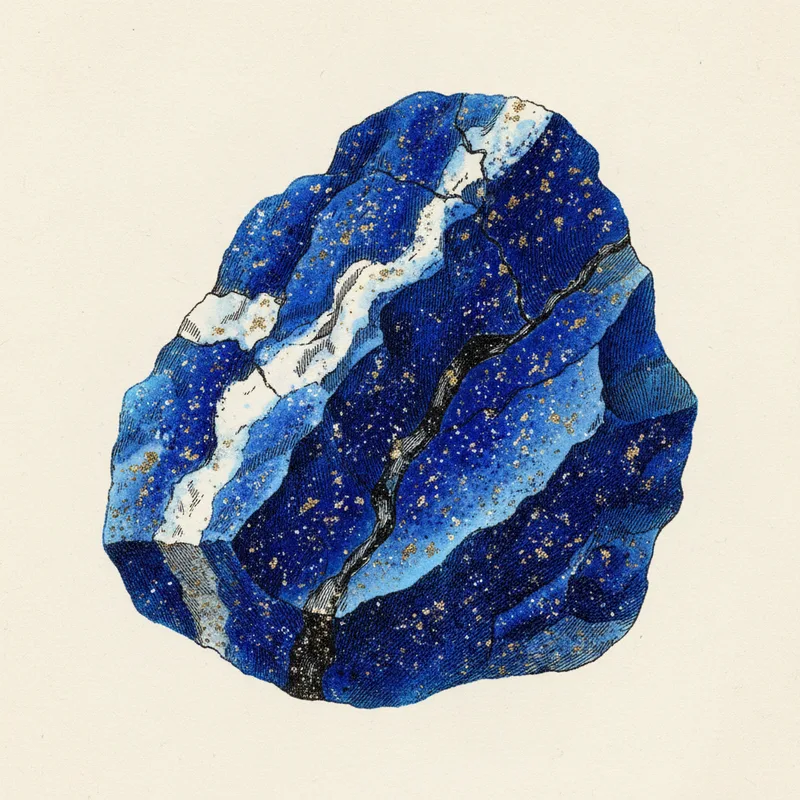
Lapis lazuli is a metamorphic rock, not a single mineral. Its blue comes from lazurite, a complex tectosilicate with the formula (Na,Ca)₈(AlSiO₄)₆(S,SO₄,Cl)₁₋₂. White patches are calcite. Golden metallic flecks are pyrite. This trio of components has made lapis one of the most prized ornamental stones for over six millennia, and people have been faking it for nearly that long. Modern counterfeits are usually dyed jasper or dyed howlite.
What the fake looks like: Too uniformly blue, too smooth, too perfect. Dyed jasper lapis tends to look flat and chalky up close. The "pyrite" on fakes is sometimes gold-colored paint or glued-on metallic flakes, which look dull and unconvincing under magnification. Some fakes lack calcite entirely, which is actually the giveaway, since even top-grade Afghan lapis has at least some visible calcite.
What real lapis looks like: Genuinely complex. You'll see deep ultramarine lazurite alongside white or pale gray calcite veins and irregular scatterings of pyrite that catch the light like tiny gold mirrors. The blue has depth and richness that surface dye can't replicate. Premium lapis from Afghanistan's Sar-e-Sang mines has been the world standard for 6,000 years for a reason.
How to test it:
- Inspect the pyrite. Under 10x magnification, real pyrite in lapis appears as irregular, angular metallic crystals embedded within the rock, catching light at different angles. Painted "pyrite" is flat, dull, and uniform.
- The acetone test. Rub a cotton swab dampened with acetone against the stone's surface. Dyed stones will surrender blue color to the cotton. Real lapis will not.
- Measure specific gravity. Real lapis falls between 2.7 and 2.9. If you can do a simple water displacement test (weigh the stone dry, weigh it suspended in water, divide), this single measurement eliminates most fakes immediately.
7. Rose Quartz
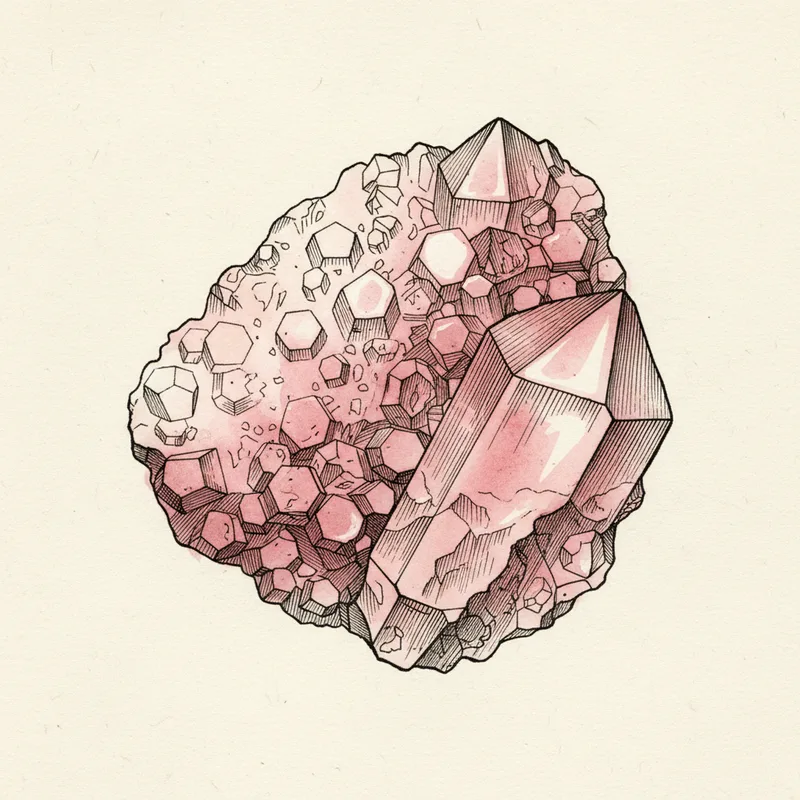
Rose quartz gets its delicate pink from trace amounts of titanium, iron, or manganese substituting into the SiO₂ lattice, or from microscopic fibrous inclusions of a pink dumortierite-like mineral. The key word in that sentence is "delicate." Real rose quartz is subtle. Fakes are not.
What the fake looks like: Two main varieties. Dyed clear quartz is intensely, almost neon pink, sometimes verging on hot magenta. Glass fakes are perfectly transparent with uniform rosy color and may contain small bubbles. Both look dramatically more vivid than any specimen you'd find in nature.
What real rose quartz looks like: A soft, milky, slightly cloudy pink. Most specimens are translucent rather than transparent, with a gentle haze that diffuses the color. The pink is never hot, never vivid, never saturated enough to make you think of bubblegum. Transparent gem-grade rose quartz does exist but is rare, expensive, and always sold with documentation.
How to test it:
- Judge the color honestly. If it's hot pink, bubblegum, or neon, it's either dyed or glass. Natural rose quartz is the color of pink diluted with fog.
- Look for internal character. Real rose quartz almost always has some cloudiness, haziness, or veil-like inclusions. Perfectly water-clear pink with no internal features is suspect unless the price tag reflects gem-grade rarity.
- The scratch test. Quartz has a Mohs hardness of 7. It will readily scratch a glass plate or steel knife blade. Pink glass (hardness ~5.5) will not scratch regular glass. This is one of the most reliable quick tests for any quartz variety.
8. Smoky Quartz
Smoky quartz is the trickiest entry on this list because the "fake" is chemically identical to the real thing. Natural smoky quartz gets its brown-to-gray color from aluminum impurities in the SiO₂ lattice that get displaced by natural background radiation over geological time, creating color centers. The catch is that you can achieve the same result artificially by blasting clear quartz with gamma radiation for a few hours.
Irradiated quartz isn't synthetic. It's real quartz with a real color change. But it's not what collectors mean when they say "natural smoky quartz," and the treatment dramatically affects value.
What the fake looks like: Artificially irradiated smoky quartz tends to be extremely dark, sometimes nearly opaque black, with unnaturally uniform coloration throughout the crystal. Some irradiated pieces pick up a slightly grayish or subtly greenish cast that natural smokies rarely exhibit.
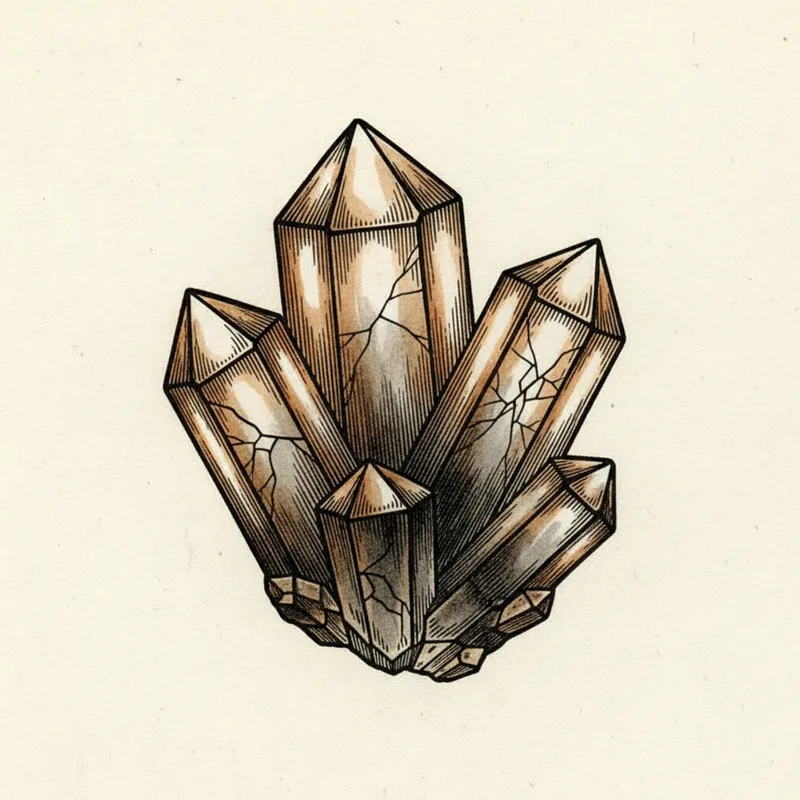
What real smoky quartz looks like: Warm brown tones ranging from light tea to deep chocolate, with subtle color zoning and variation within a single crystal. You can typically see through even darker specimens if you hold them to a light source. The finest natural specimens come from the Swiss Alps, Brazilian pegmatites, and Scotland's Cairngorm Mountains.
How to test it:
- Evaluate the darkness and uniformity. Jet-black, perfectly uniform "smoky quartz" with zero transparency is almost certainly irradiated. Natural smokies have gradients, zoning, and warmth to their color.
- Ask about provenance. Sellers of genuine natural smoky quartz know their source localities and are proud of them. If the seller can't tell you where the quartz was mined, treat the "natural" label skeptically.
- Let price inform your judgment. A large, jet-black smoky quartz tower for $15 is irradiated. Natural smoky quartz of comparable size from a documented locality costs considerably more.
9. Opalite vs. Opal
This isn't a counterfeit in the traditional sense. It's a naming scam. Opalite is manufactured glass, typically a blend of dolomite and metal oxides designed to produce an opalescent shimmer. It's pretty. It's cheap. And it is not, in any way, a naturally occurring gemstone. But TikTok and Etsy are saturated with listings calling it "opalite opal," "sea opal," "rainbow opalite crystal," or simply "opal."
What opalite looks like: A milky, translucent glass with a distinctive blue glow against light backgrounds and an orange-pink glow against dark backgrounds. It's perfectly uniform, perfectly smooth, and available in perfectly identical shapes across dozens of sellers. That uniformity is the tell. Nature doesn't do uniformity.
What real opal looks like: Genuine opal (SiO₂·nH₂O) displays play-of-color, distinct flashes of spectral red, green, blue, and orange that shift and dance as you rotate the stone. This phenomenon comes from light diffracting through ordered arrays of silica nanospheres within the gem, and it is physically impossible to replicate with simple glass. Opalite's diffuse glow and opal's spectral fire look nothing alike in person.
How to tell them apart:
- Look for play-of-color. Real opal shows sharp, distinct flashes of spectral color that appear, shift, and vanish as you change the viewing angle. Opalite produces a soft, diffuse glow with no discrete color flashes. Once you've seen both side by side, you'll never confuse them again.
- Compare prices. Quality precious opal sells for $50-500+ per carat. If a large pendant labeled "opal" costs $12, it's opalite glass.
- Ask the question directly. Reputable sellers will plainly state that opalite is man-made glass. If a seller calls it "natural opalite," "organic opal," or refuses to clarify, take your money elsewhere.
10. Amazonite
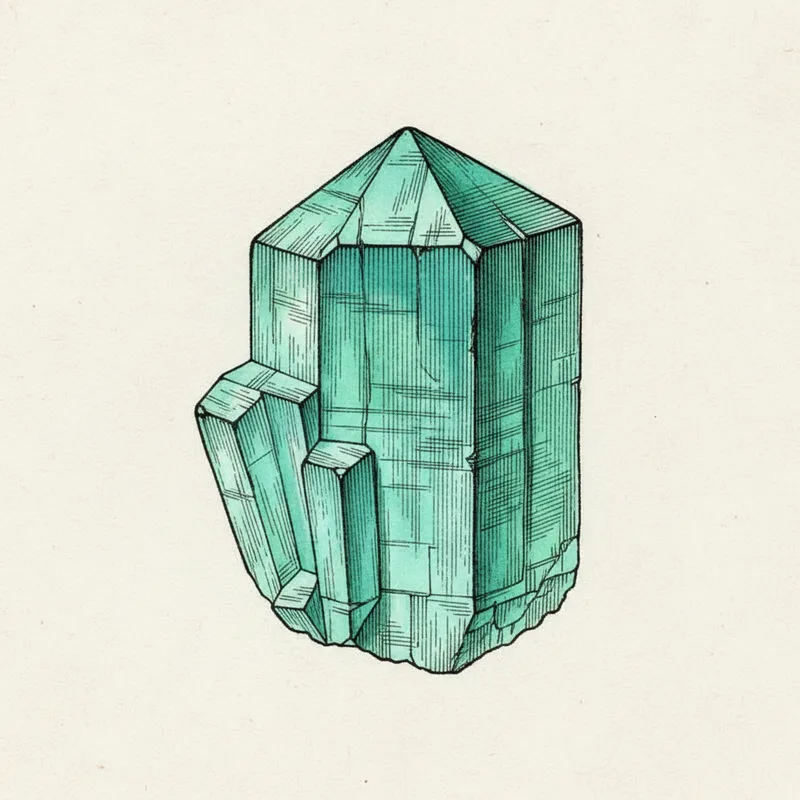
Amazonite is a green to blue-green variety of microcline feldspar (KAlSi₃O₈) with a color that puzzled mineralogists for decades. Research has shown the green comes from trace amounts of lead (Pb²⁺) and water molecules occupying structural positions in the crystal lattice, absorbing light in the red-yellow spectrum and transmitting the blue-green. As amazonite's popularity has surged, so have dyed quartz and glass substitutes.
What the fake looks like: Dyed quartz sold as amazonite is typically too uniformly green, lacking the white streaks and mottled texture that define genuine amazonite. Some fakes use dyed chalcedony or green glass. The green in fakes often looks like it was applied rather than grown, sitting on the surface rather than emanating from within.
What real amazonite looks like: A distinctive blue-green to green body color shot through with white streaks and patches of albite feldspar, a mineral that commonly intergrows with microcline. The color is rarely perfectly uniform. Real amazonite has a vitreous luster and sits at 6-6.5 on the Mohs scale. Specimens from Colorado, Russia, and Madagascar each have slightly different character, but the white-streaked appearance is consistent.
How to test it:
- Look for white streaking. Genuine amazonite almost always shows white or cream-colored bands of albite feldspar running through the green. Perfectly uniform green without any streaking or mottling is a significant warning sign.
- Test the hardness. Real amazonite (6-6.5) scratches glass easily. Dyed glass substitutes won't scratch other glass since both are around 5.5. Dyed howlite (3.5) is far too soft and fails this test immediately.
- Check for cleavage. Feldspar minerals exhibit two planes of cleavage intersecting at nearly 90 degrees. Under a hand lens, you can sometimes spot flat, reflective cleavage surfaces on broken or rough edges. Glass and dyed quartz don't exhibit this two-directional cleavage.
The Bottom Line
The pattern across all ten of these fakes is consistent: real minerals are messy. They have inclusions, color variation, asymmetric patterns, and subtle hues that took millions of years to develop. When a crystal looks too vivid, too uniform, or too perfect, it almost certainly is.
A few principles that will save you money across the board:
- Buy from sellers who disclose treatments. Heat treatment and irradiation are standard industry practices, and they aren't inherently dishonest. What's dishonest is not telling you. Ethical sellers label treated stones.
- Calibrate your eye with museum specimens. Browse the mineral collections at your local natural history museum or reputable dealers' reference photos online. Once you know what real citrine or real turquoise looks like, the fakes become obvious.
- Never rely on color alone. Color is the single easiest property to fake. Ground your identification in hardness, specific gravity, surface texture, and internal features instead.
- Let price be a data point. Rare minerals cost real money. If moldavite is $3 a piece, if a large lapis sphere is $20, if a huge smoky quartz tower is $12, something is wrong. Geology doesn't do discounts.
For the full walkthrough on universal testing methods, including temperature response, hardness kits, UV fluorescence, and magnification techniques, read our complete guide to testing crystals.
One last thing. There's no shame in owning a dyed howlite bead or a heat-treated amethyst if you like how it looks. Plenty of treated stones are genuinely beautiful. The problem isn't the treatment. It's being charged natural-grade prices for something that isn't. Know what you're buying, pay what it's worth, and enjoy your collection with open eyes.
Crystals in This Article
Rainbow Obsidian
The Stone of Light in Darkness

Blue Obsidian
The Rarest Volcanic Glass
Lapis Lazuli
The Stone of the Heavens
Clear Quartz
The Master Healer
Smoky Quartz
The Grounding Stone
Dumortierite
The Patience Stone
Rose Quartz
The Stone of Unconditional Love
Chalcedony
The Mother of Agates
Malachite
The Stone of Transformation
Turquoise
The Sky Stone
Amazonite
The Hope Stone
Moldavite
The Stone from the Stars
Keep Reading
Stay in the loop
From the Almanac
Updates from Crystal Almanac, when there’s something worth sharing.