Quick Facts
Formation & Origin
Here's a fact that surprises most people: virtually all black onyx is dyed. Natural solid black onyx is extremely rare in nature. The overwhelming majority of 'black onyx' in jewelry and the crystal market is gray or pale agate that has been dyed black using a sugar-acid treatment that has been practiced for thousands of years.
The traditional process involves soaking pale agate in a sugar solution for weeks, then treating it with sulfuric acid. The acid carbonizes the sugar that has penetrated the stone's microscopic pores, turning it permanently black. This treatment is ancient (practiced by the Romans), permanent, and universally accepted in the gem trade - but almost never disclosed to consumers.
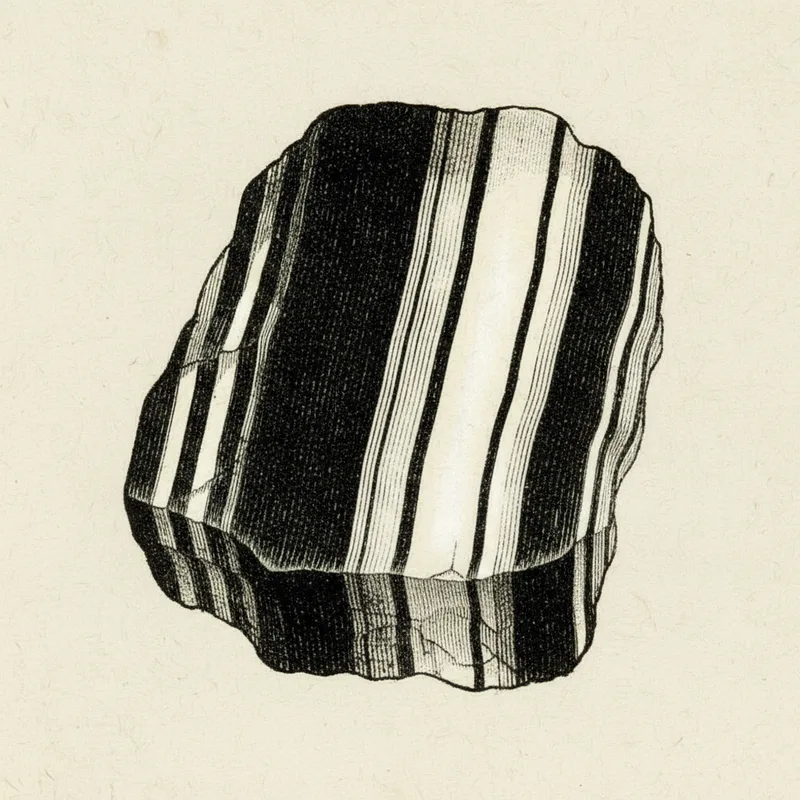
True onyx, mineralogically speaking, is banded chalcedony with alternating black and white layers. 'Sardonyx' has brown/red and white bands. The term 'onyx' has evolved in the marketplace to mean solid black chalcedony regardless of whether it's natural or treated.
Identification Guide
Black onyx is identified as solid black chalcedony at hardness 7. In practice, identification means determining whether it's natural or dyed - and it's almost always dyed.
Distinguish from obsidian (volcanic glass, conchoidal fracture, slightly translucent at thin edges), black tourmaline (crystal faces, striations), jet (organic, much lighter weight), and black spinel (much denser, vitreous rather than waxy). Under strong transmitted light, dyed onyx may show the original banding of the agate that was dyed.
Spotting Fakes
The irony is that black onyx itself is essentially a 'fake' in the sense that natural solid black onyx barely exists. The dyeing treatment is so universal and longstanding that the gem trade considers it standard. The real question is whether the base material is genuine agate/chalcedony or glass/plastic. Glass imitations are warmer to the touch, may contain bubbles, and lack the fine texture of genuine chalcedony. Plastic imitations are much lighter and scratch easily.
Cultural & Metaphysical Traditions
Presented as cultural traditions, not scientific evidence
In ancient Rome, onyx was carved into cameos and intaglios (carved seal stones). Soldiers carried onyx into battle for strength and courage. In Indian tradition, onyx is believed to absorb negative energy. Arabic and Hebrew traditions associated onyx with grief and sorrow - it was worn during mourning. Modern crystal practitioners associate black onyx with grounding, protection, and inner strength. It's one of the most popular stones in men's jewelry.
Where It's Found
Major source of dyed black onyx
Traditional cutting and dyeing center
Source material for treated onyx
Some natural dark material
Price Guide
Good to Know
Scratch test: At hardness 7, Black Onyx can scratch glass and steel. It's durable enough for any type of jewelry.
Sources: Found in 4 notable locations worldwide, from Brazil to Madagascar.
Heft test: Black Onyx has average mineral density (2.60). It feels about as heavy as you'd expect from a stone its size.
Explore More
Stay in the loop
From the Almanac
Updates from Crystal Almanac, when there’s something worth sharing.