Quick Facts
Formation & Origin
Obsidian isn't technically a mineral. It's a volcanic glass. It forms when felsic lava (rich in silica) erupts and cools so rapidly that atoms don't have time to arrange into a crystal lattice. The result is a solid with the chemical composition of granite but the atomic structure of a liquid, frozen in an instant.
This rapid cooling typically happens when lava contacts water, air, or the edge of a lava flow. The entire process can take hours to days, vanishingly fast in geological terms. Because obsidian is metastable, it slowly devitrifies over millions of years, meaning ancient obsidian gradually transforms from glass into tiny crystals. This is why obsidian older than about 20 million years is extremely rare.
Varieties like snowflake obsidian contain cristobalite inclusions, small, radial crystal formations that formed as the glass began its slow transformation. Rainbow obsidian gets its iridescent sheen from nanoscale layers of magnetite crystals aligned within the glass. Mahogany obsidian contains iron oxide inclusions that create warm brown streaks.
Identification Guide
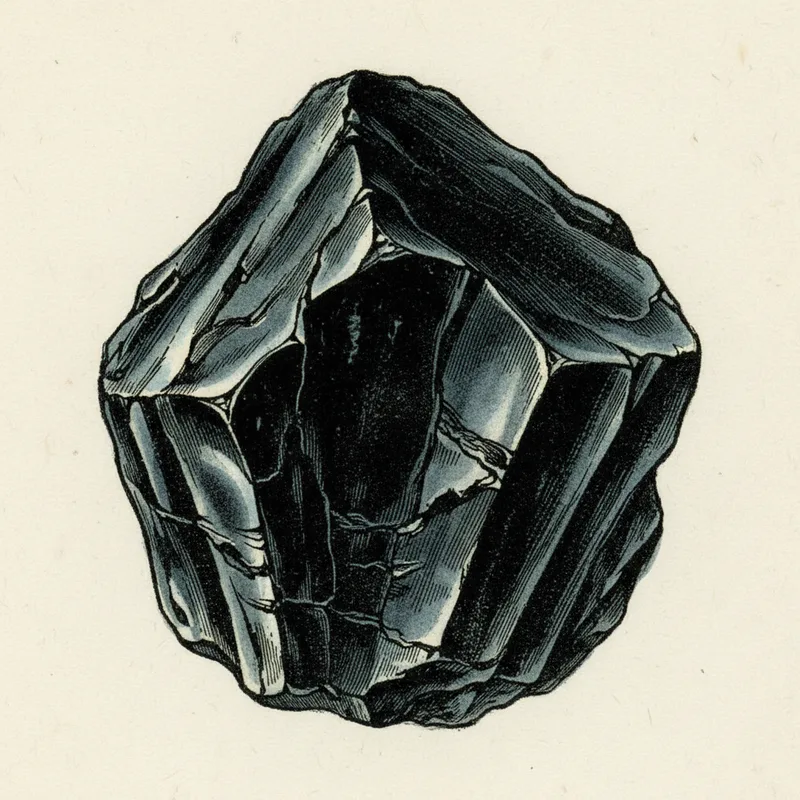
Obsidian is distinctive: glassy luster, conchoidal fracture, and typically jet black. It fractures into curved, razor-sharp edges. Prehistoric peoples exploited this property to create blades sharper than modern surgical steel. At 5-5.5 on the Mohs scale, it's softer than quartz and can be scratched by a steel file.
Distinguish it from black tourmaline (which has a matte, striated surface), black onyx (banded chalcedony, waxy luster), and jet (organic, much lighter weight). Obsidian's sharp, glassy fracture surfaces are its most reliable diagnostic feature. Hold it up to strong light. Thin edges of genuine obsidian will be slightly translucent, usually with a brown or gray tint.
Spotting Fakes
Black glass beads and molded glass are sometimes sold as obsidian, especially online. Real obsidian has small imperfections: flow banding, tiny bubbles, slight color variations. Perfectly uniform, flawless 'obsidian' spheres at very low prices are likely manufactured glass. Genuine obsidian also tends to be lighter in weight than it looks. 'Blue obsidian' and 'green obsidian' in bright saturated colors are almost always dyed glass. Natural obsidian doesn't come in vivid blues or greens.
Cultural & Metaphysical Traditions
Presented as cultural traditions, not scientific evidence
Aztec priests used obsidian mirrors for divination and named the stone 'itzli,' the god of stone. Ancient Greeks associated it with protection against negativity. In Mesoamerican cultures, obsidian blades were sacred instruments used in ceremony. Modern crystal practitioners use obsidian for grounding, protection, and confronting difficult truths.
Where It's Found
Rainbow and mahogany obsidian, ancient Aztec source
Large flows, snowflake and rainbow varieties
One of humanity's oldest obsidian sources
Massive volcanic formations, jet black specimens
Historically prized for Jōmon-era tool making
Price Guide
Good to Know
Scratch test: At hardness 5.5, Obsidian resists scratching from a knife but can be scratched by quartz. Best for pendants and earrings rather than rings.
Sources: Found in 5 notable locations worldwide, from Mexico to Japan.
Heft test: With a specific gravity of 2.35–2.60, Obsidian feels lighter than most minerals. This lightness can help identify it.
Related Minerals
Rounded, translucent obsidian nodules
Same composition but gas-filled and lightweight
Crystallized version of the same magma
Impact glass, similar but extraterrestrial origin
Explore More
Volcanic & Impact Glass
The Protection Collection
Aztec priests used obsidian mirrors for scrying and protection. The volcanic glass has been associated with shielding across Mesoamerican cultures for millennia.
The Grounding Collection
Volcanic glass - literally born from the Earth's interior. Its solid, grounding quality has been recognized since the Stone Age.
The Beginner's Collection
Volcanic glass, not a mineral at all. Teaches you that 'crystal' is a broad category - some of the most interesting specimens have no crystal structure whatsoever.
The Healing Collection
Mesoamerican surgeons used obsidian blades for precise cuts. Modern surgical research has confirmed obsidian scalpels produce cleaner incisions than steel under electron microscopy.
The Travel Collection
Aztec traders carried obsidian for protection and to create sharp tools when needed. Its volcanic origin connects it to the transformative power of travel - entering new worlds.
The Grief Collection
Black volcanic glass used in mourning rituals across Mesoamerican cultures. Its ability to form mirror surfaces made it a tool for confronting and processing difficult truths during grief.
Best Crystals for Grief and Loss
Taurus Season Crystals: 6 Stones for Stability and Abundance
Obsidian vs Black Tourmaline: Volcanic Glass vs Crystal
Mohs Hardness Scale
See where Obsidian sits on the scale
Crystal Care Guide
Water safety, sunlight, and handling tips
Stay in the loop
From the Almanac
Updates from Crystal Almanac, when there’s something worth sharing.