Quick Facts
Formation & Origin
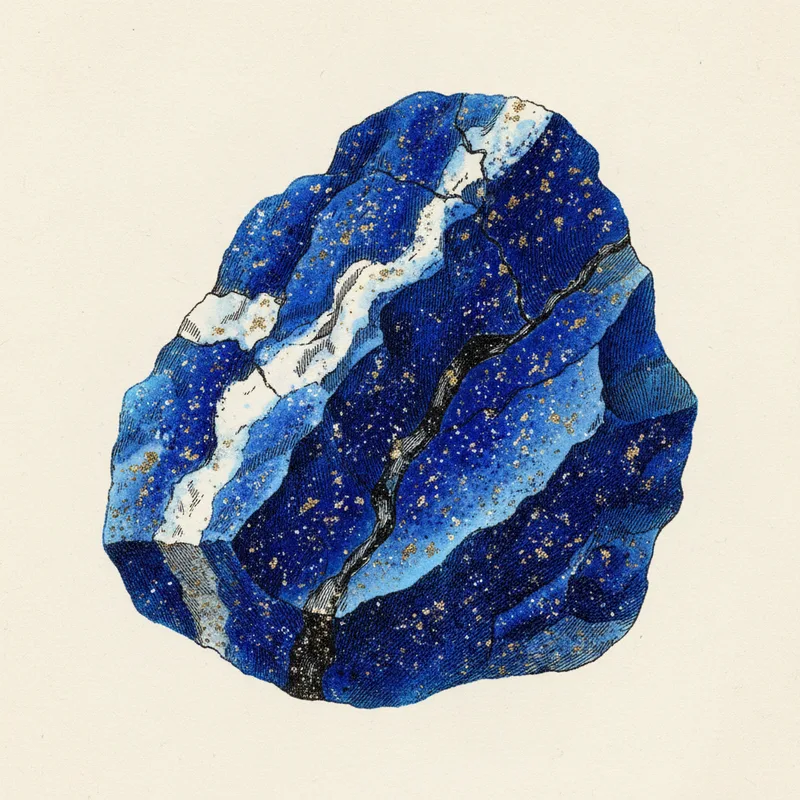
Lapis lazuli is not a single mineral - it's a metamorphic rock composed primarily of lazurite (which provides the blue), calcite (white), and pyrite (metallic gold). It forms when limestone is subjected to contact metamorphism - heated and chemically altered by the intrusion of nearby magma.
During this process, the calcium carbonate of the limestone reacts with sulfur-bearing fluids from the magma, forming lazurite and other sulfur-containing minerals. The transformation happens at temperatures between 500-600 degrees Celsius, deep enough underground that pressure keeps the volatile sulfur compounds from escaping.
The finest lapis comes from the Sar-e-Sang mines in the Kokcha River valley of Afghanistan - the same source that supplied the ancient Egyptians, Mesopotamians, and Indus Valley civilizations. These mines sit at an elevation of over 2,500 meters in the Hindu Kush mountains, and their lapis is prized for its intense, uniform blue with minimal calcite and just enough pyrite to add golden sparkle.
Identification Guide
Quality lapis lazuli has a deep, uniform blue color without excessive white calcite patches. The scattered flecks of gold-colored pyrite are considered desirable - they resemble stars in a night sky. A blue streak on unglazed porcelain confirms the presence of lazurite.
Lapis is easily distinguished from sodalite (which it resembles but which lacks pyrite and tends toward a more violet-blue). It's also softer than many blue gemstones - at 5.5 Mohs, it can be scratched by a steel knife. The calcite component will effervesce (fizz) if you apply a drop of hydrochloric acid to an inconspicuous spot, which confirms the rock identity.
Spotting Fakes
Dyed howlite and dyed jasper are commonly sold as lapis lazuli, especially in bead strands and tourist jewelry. The dye tends to concentrate in cracks and show uneven color distribution - examine the drill holes of beads, where dye often pools. Genuine lapis has a slightly granular texture under magnification. 'Swiss lapis' and 'German lapis' are trade names for dyed jasper - not lapis at all. Synthetic lapis (created by Gilson) exists but is rare in the market. The acetone test can reveal dye - a cotton swab dampened with acetone will pick up color from dyed fakes.
Cultural & Metaphysical Traditions
Presented as cultural traditions, not scientific evidence
Lapis lazuli was more precious than gold in ancient Egypt - Cleopatra is said to have used powdered lapis as eyeshadow. The funeral mask of Tutankhamun features prominent lapis inlays. Renaissance painters ground lapis into ultramarine pigment - the most expensive paint color of the era, reserved for the robes of the Virgin Mary. In Buddhist tradition, lapis represents the healing power of the Medicine Buddha.
Where It's Found
World's finest, continuously mined for 6,500+ years
Lighter blue color, significant modern producer
Deep blue specimens, historic Russian source
Small quantities of fine quality material
Price Guide
Good to Know
Scratch test: At hardness 5.5, Lapis Lazuli resists scratching from a knife but can be scratched by quartz. Best for pendants and earrings rather than rings.
Sources: Found in 4 notable locations worldwide, from Afghanistan to Myanmar.
Heft test: Lapis Lazuli has average mineral density (2.70-2.90). It feels about as heavy as you'd expect from a stone its size.
Related Minerals
Similar blue color, no pyrite, more affordable
Another deep blue mineral, copper-based
The primary blue mineral within lapis rock
Blue silicate sometimes confused with lapis
Explore More
Rocks & Multi-Mineral Composites
The Communication Collection
The stone of the Egyptian goddess Ma'at, who represented truth. Ground into pigment for medieval illuminated manuscripts.
The Healing Collection
Prescribed in Ayurvedic medicine for centuries. Ground into powder and used in traditional Persian medicine. The deep connection to truth and clarity extends to healing practices across cultures.
Best Crystals for Grief and Loss
Lapis Lazuli vs Sodalite: The Blue Rock Conundrum
Best Crystals for Manifestation: A Practical Guide
Mohs Hardness Scale
See where Lapis Lazuli sits on the scale
Crystal Care Guide
Water safety, sunlight, and handling tips
Stay in the loop
From the Almanac
Updates from Crystal Almanac, when there’s something worth sharing.