Quick Facts
Formation & Origin
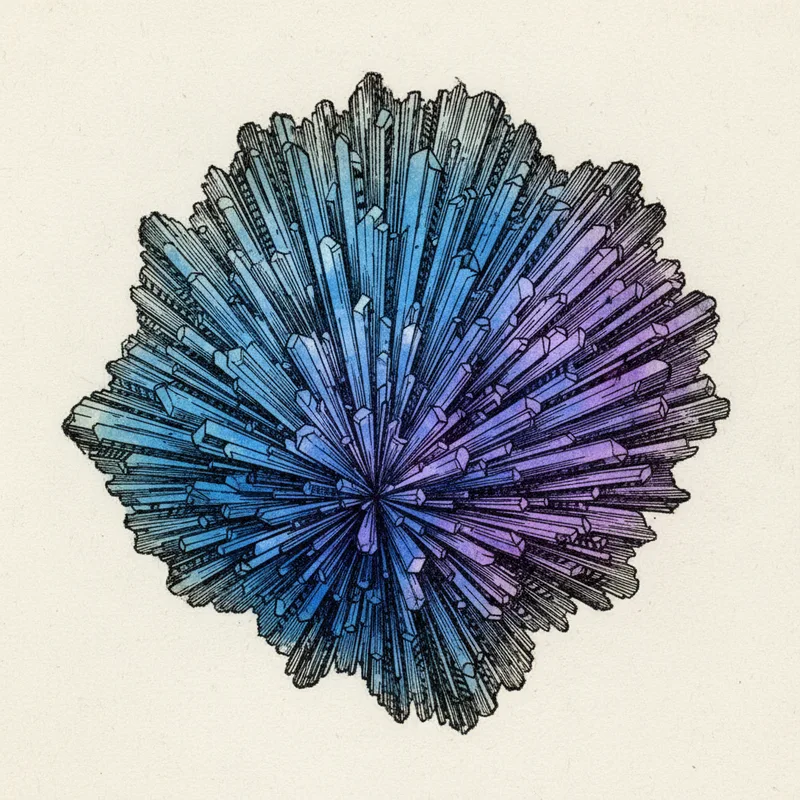
Dumortierite is a boron-bearing aluminum silicate that forms in aluminum-rich metamorphic rocks - specifically in high-grade metamorphic environments where boron is available. It typically occurs as fibrous aggregates within schists, gneisses, and pegmatites.
The deep blue color comes from intervalence charge transfer between iron and titanium within the crystal structure - the same mechanism that colors blue sapphire. This makes dumortierite one of the few relatively affordable minerals that achieves a genuinely deep blue through a 'precious' coloring mechanism.
Dumortierite commonly occurs included within quartz, creating 'dumortierite quartz' - a blue, opaque to translucent material that's harder and more durable than massive dumortierite alone. This variety is popular in lapidary work and produces attractive cabochons.
Identification Guide
Dumortierite is identified by its deep blue to violet-blue color, fibrous habit, and hardness of 7. The fibrous crystal structure gives broken surfaces a splintery appearance.
Distinguish from sodalite (more uniform color, associated with white), lapis lazuli (contains pyrite, different minerals), and blue kyanite (bladed habit, different hardness variation). Dumortierite's fibrous texture visible under magnification is diagnostic.
Spotting Fakes
Dumortierite is affordable enough that direct faking is uncommon. The main confusion is with sodalite and lapis lazuli, both of which are different minerals. Dyed blue quartz or chalcedony may be sold as dumortierite - genuine dumortierite has a fibrous, somewhat uneven texture rather than the smooth, waxy feel of dyed chalcedony.
Cultural & Metaphysical Traditions
Presented as cultural traditions, not scientific evidence
Named after French paleontologist Eugene Dumortier who discovered it in 1881. Dumortierite has no ancient traditions due to its relatively recent identification. Modern crystal practitioners associate it with patience, organization, and mental clarity. It's sometimes called the 'student's stone' for its purported ability to enhance learning and memory retention. In some traditions, it's connected to past-life recall.
Where It's Found
Fine vivid blue material, major source
Good quality blue specimens
Cabochon-grade material
Dumortierite in quartz varieties
Price Guide
Good to Know
Scratch test: At hardness 7, Dumortierite can scratch glass and steel. It's durable enough for any type of jewelry.
Sources: Found in 4 notable locations worldwide, from Mozambique to United States.
Heft test: Dumortierite has average mineral density (3.30). It feels about as heavy as you'd expect from a stone its size.
Explore More
Other Silicates & Gems
Best Crystals for Grief and Loss
Taurus Season Crystals: 6 Stones for Stability and Abundance
Spring Crystal Rituals: Stones for New Beginnings
Mohs Hardness Scale
See where Dumortierite sits on the scale
Crystal Care Guide
Water safety, sunlight, and handling tips
Stay in the loop
From the Almanac
Updates from Crystal Almanac, when there’s something worth sharing.