Quick Facts
Formation & Origin
Pearls form when an irritant (a parasite, not a grain of sand - the sand myth is wrong) becomes lodged in a mollusk's tissue. The animal coats the irritant with nacre - alternating microscopic layers of aragonite (calcium carbonate) platelets and conchiolin (organic protein). These layers build up over years, eventually creating a pearl.
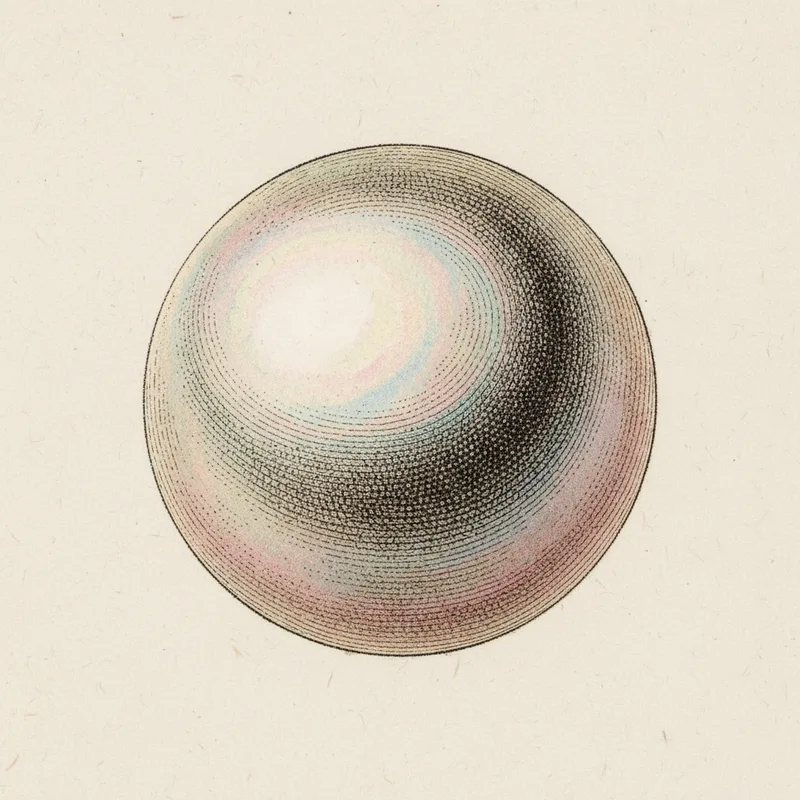
Nacre's beauty comes from its layered structure. The aragonite platelets are roughly the same thickness as the wavelength of visible light, so they act as a natural diffraction grating - splitting and reflecting light to create the luminous, iridescent quality called 'orient.' The more uniform and numerous the nacre layers, the finer the pearl's luster.
Natural pearls (formed without human intervention) are extraordinarily rare today. Virtually all pearls on the market are cultured - a technician surgically inserts a bead nucleus into the mollusk, which then coats it with nacre over 1-5 years. Kokichi Mikimoto patented the cultured pearl process in 1893, democratizing what had been the world's most exclusive gem.
Identification Guide
Pearls are identified by their characteristic pearly luster, organic origin, and the 'tooth test' - rub a pearl gently against the biting edge of your front teeth. Genuine nacre feels slightly gritty (the edges of aragonite platelets), while plastic or glass imitations feel smooth.
Distinguish from shell pearls (coated glass beads - too perfect, too heavy), plastic imitations (smooth tooth test, lighter), and Majorica pearls (high-quality glass imitations from Mallorca). Under magnification, genuine nacre shows overlapping platelet edges; imitations show paint or coating layers.
Spotting Fakes
The tooth test is the simplest and most reliable field test for pearls. Beyond that: genuine pearls have slight surface irregularities and vary slightly from each other in a strand; perfect uniformity suggests imitation. X-ray examination can distinguish natural from cultured pearls by revealing the nucleus. For valuable strands, a lab report from GIA confirms whether pearls are natural, cultured, or imitation. The terms 'saltwater' and 'freshwater' describe the mollusk's habitat, not the pearl's quality.
Cultural & Metaphysical Traditions
Presented as cultural traditions, not scientific evidence
Pearls have been treasured since antiquity - Cleopatra famously dissolved a pearl in vinegar and drank it to win a bet about hosting the most expensive dinner. In Hindu tradition, pearls are associated with the moon and are one of the navaratna (nine sacred gems). Chinese tradition associates pearls with dragons - legends say pearls fell from the sky when dragons fought. In Western tradition, pearls symbolize purity and were required adornments for Renaissance nobility. June birthstone.
Where It's Found
Finest white and golden South Sea pearls
Black Tahitian pearls
Akoya pearls, Mikimoto's pioneering farms
World's largest producer by volume
Price Guide
Good to Know
Scratch test: At hardness 3, Pearl can be scratched with a copper coin. Handle gently and keep away from harder stones in your collection.
Sources: Found in 4 notable locations worldwide, from Australia to China.
Heft test: Pearl has average mineral density (2.70). It feels about as heavy as you'd expect from a stone its size.
Related Minerals
The mineral that forms nacre's crystalline layers
The nacre lining of the shell itself
Produces colorful nacre but different from pearl
Another organic marine gem
Explore More
Stay in the loop
From the Almanac
Updates from Crystal Almanac, when there’s something worth sharing.