Quick Facts
Formation & Origin
Pyrite forms across a remarkably wide range of geological environments - from boiling hydrothermal vents on the ocean floor to cold, oxygen-poor sedimentary basins. This versatility makes it the most common sulfide mineral on Earth.
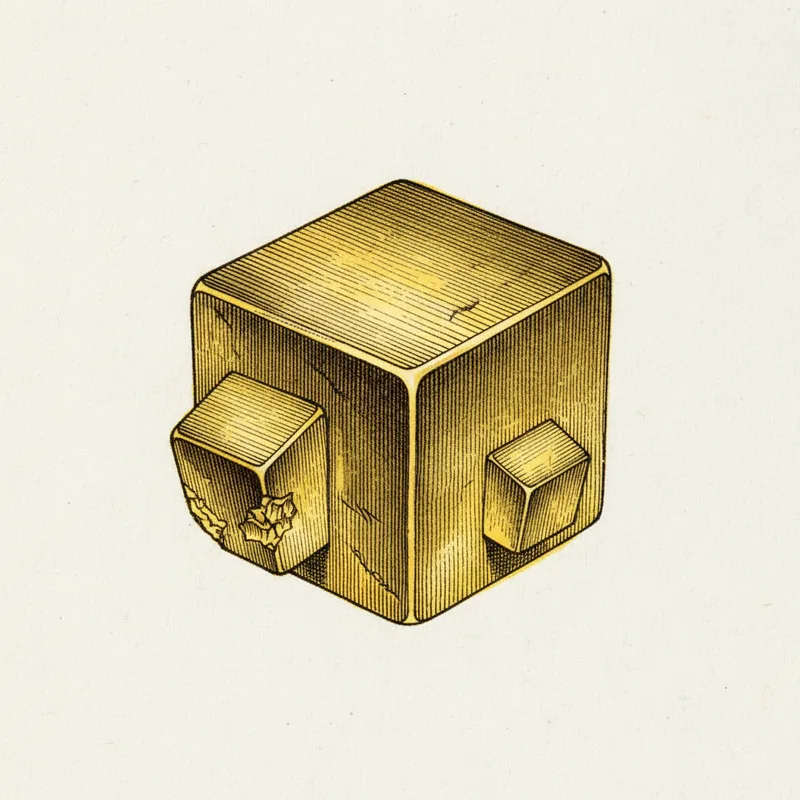
In hydrothermal systems, pyrite crystallizes from sulfur-rich fluids as they cool below about 500 degrees Celsius. The crystals from Navajun, Spain - some of the most perfect cubes found anywhere in nature - grew in marl (a type of mudstone) from low-temperature fluids over millions of years, which allowed the slow, orderly atomic arrangement that produces those eerily geometric shapes.
Pyrite also forms in sedimentary environments when iron reacts with hydrogen sulfide produced by bacteria in oxygen-poor muds. This is how the tiny pyrite framboids (raspberry-shaped clusters of microscopic crystals) found in black shales originate. In fossils, pyrite often replaces the original organic material atom by atom, preserving intricate details of ancient organisms in gleaming metallic gold.
Identification Guide
Pyrite's metallic luster and brass-yellow color make it one of the most recognizable minerals. The classic confusion is with gold - hence 'fool's gold.' But the distinction is straightforward: gold is soft (2.5 Mohs), malleable, and has a gold streak. Pyrite is hard (6.5 Mohs), brittle, and leaves a greenish-black streak. Scratch it on unglazed porcelain and the question is immediately settled.
Pyrite's crystal habits are also diagnostic - perfect cubes, pyritohedrons (twelve-faced forms), and octahedrons are all common and distinctive. Its high specific gravity (5.0) gives it a satisfying heft. On broken surfaces, pyrite shows conchoidal to uneven fracture rather than cleavage.
Spotting Fakes
Pyrite itself is almost never faked (it's too common and inexpensive), but pyrite specimens are sometimes enhanced. Watch for specimens with unnaturally uniform golden color that may have been acid-washed to remove tarnish. Some 'perfect cubes' from lesser localities have been cut and polished to simulate the natural cubic crystals from Navajun. The Navajun cubes have distinctive striations (fine parallel lines) on their faces - polished fakes lack these. Also, 'pyrite suns' (flat, circular pyrite formations) are genuine geological oddities, not manufactured.
Cultural & Metaphysical Traditions
Presented as cultural traditions, not scientific evidence
The name comes from the Greek 'pyr' meaning fire - striking pyrite against steel produces sparks, making it one of humanity's earliest fire-starting tools. Inca civilizations used polished pyrite as mirrors. Victorian-era jewelry featured cut and polished pyrite, then called 'marcasite.' Modern crystal practitioners associate pyrite with wealth, confidence, and shielding against negative energy.
Where It's Found
Perfect cubic crystals, world's most iconic locality
Massive pyritohedron crystals, often with quartz
Classic octahedral and pyritohedral habits
Excellent specimens from various geological settings
Price Guide
Good to Know
Scratch test: At hardness 6.5, Pyrite resists scratching from a knife but can be scratched by quartz. Best for pendants and earrings rather than rings.
Sources: Found in 4 notable locations worldwide, from Spain to United States.
Heft test: With a specific gravity of 5.01, Pyrite feels surprisingly heavy for its size. This weight is actually a useful identification tool.
Explore More
Sulfide Minerals
The Abundance Collection
'Fool's gold' - its resemblance to gold is so convincing it fooled prospectors. Associated with attracting wealth and recognizing opportunity.
The Manifestation Collection
Fool's gold that fools nobody - practitioners know exactly why they reach for it. Its metallic luster and cubic crystal form represent the geometry of material goals becoming real.
The Confidence Collection
Brass and fire. Pyrite's metallic luster and perfect cubic crystals embody the confidence of mathematical precision. Associated with self-worth and recognizing one's own value.
The Beginner's Collection
Perfect cubic crystals of iron sulfide. The geometry alone is worth studying. Teaches metallic luster, cubic crystal system, and introduces sulfide minerals in one affordable specimen.
The Workplace Collection
Fool's gold on the real gold standard. Its perfect cubic geometry and metallic luster are associated with wealth consciousness and the discipline to build toward material goals.
Taurus Season Crystals: 6 Stones for Stability and Abundance
Lapis Lazuli vs Sodalite: The Blue Rock Conundrum
Best Crystals for Confidence and Self-Esteem
Mohs Hardness Scale
See where Pyrite sits on the scale
Crystal Care Guide
Water safety, sunlight, and handling tips
Stay in the loop
From the Almanac
Updates from Crystal Almanac, when there’s something worth sharing.