Quick Facts
Formation & Origin
Rhodochrosite is a manganese carbonate that forms in hydrothermal veins associated with silver, copper, and lead ore deposits. The vivid pink to red color comes directly from manganese, an essential component of its chemistry.
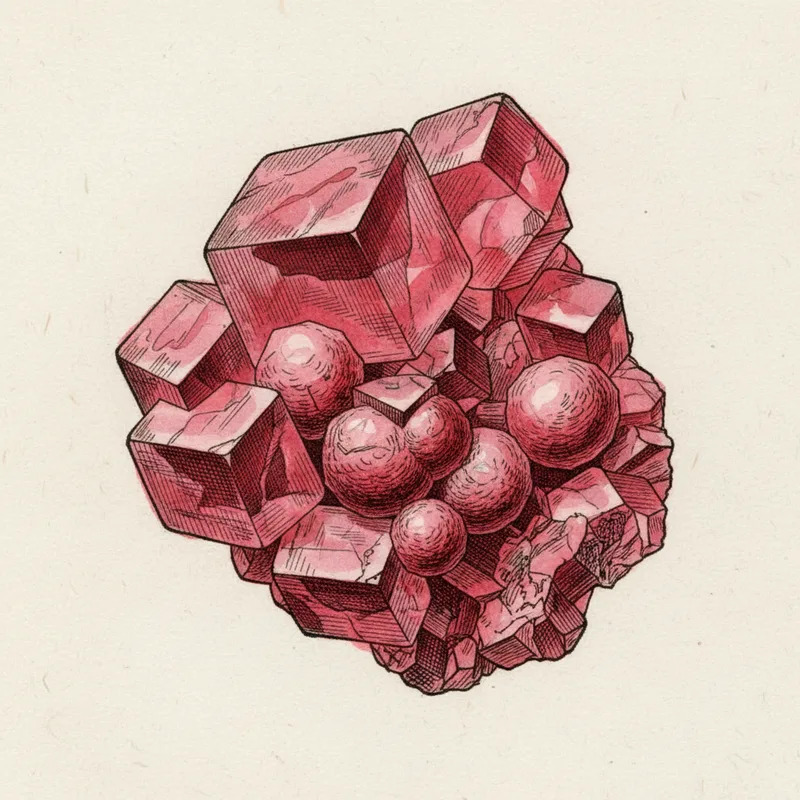
The two forms collectors encounter are dramatically different. Banded rhodochrosite (concentric rings of pink and white) forms as stalactites and stalagmites in cavities within ore veins - the Argentine Capillitas Mine produces cross-sections of these stalactites that reveal stunning rose-like banding patterns. Transparent crystalline rhodochrosite is far rarer and forms as well-defined rhombohedral crystals in hydrothermal pockets.
The Sweet Home Mine in Colorado, at 3,200 meters elevation near Alma, produced some of the world's most spectacular rhodochrosite specimens - cherry-red transparent crystals perched on quartz matrix. The Alma King, discovered in 1992, is considered by many to be the finest mineral specimen ever found in North America.
Identification Guide
Rhodochrosite is identified by its distinctive pink color, banded or crystalline habit, and carbonate properties (it fizzes in dilute hydrochloric acid). At hardness 3.5-4, it's quite soft and scratches easily.
Distinguish from rhodonite (harder at 5.5-6, no acid reaction, often has black veining), rose quartz (much harder at 7, no banding), and pink calcite (similar hardness and acid reaction, but typically paler). The banded variety with its concentric pink-and-white rings is unmistakable.
Spotting Fakes
Banded rhodochrosite is sometimes imitated by dyed pink marble or polymer clay, but the natural banding pattern is distinctive and difficult to fake convincingly. Glass and ceramic imitations lack the characteristic banding. For transparent crystals, the softness (3.5) and acid reactivity confirm carbonate identity. At current prices for fine specimens, lab authentication is worthwhile for major purchases.
Cultural & Metaphysical Traditions
Presented as cultural traditions, not scientific evidence
According to Incan legend, rhodochrosite is the blood of former rulers turned to stone - hence 'Rose of the Incas.' It's the national gemstone of Argentina, where it's called 'rosa del inca.' In modern crystal practice, rhodochrosite is considered one of the most powerful heart-healing stones, associated with self-love, emotional recovery, and compassion. The banded variety is especially popular for emotional work.
Where It's Found
Stalactitic banded material, national gemstone
World's finest transparent crystals
Stunning red crystals on quartz matrix
Banded pink material, Inca historical connection
Price Guide
Good to Know
Scratch test: At hardness 3.5, Rhodochrosite can be scratched with a copper coin. Handle gently and keep away from harder stones in your collection.
Sources: Found in 4 notable locations worldwide, from Argentina to Peru.
Heft test: Rhodochrosite has a specific gravity of 3.70 - noticeably heavier than quartz. You'll feel the density when you pick it up.
Explore More
Carbonate Minerals
The Love Collection
Called 'Rosa del Inca' - the Incan rose. Argentina's national gemstone, associated with passionate, compassionate love.
How to Store and Display Your Crystal Collection
Crystal Shapes Explained: Points, Clusters, Spheres & More
The 10 Most Expensive Crystals in the World
Mohs Hardness Scale
See where Rhodochrosite sits on the scale
Crystal Care Guide
Water safety, sunlight, and handling tips
Stay in the loop
From the Almanac
Updates from Crystal Almanac, when there’s something worth sharing.