Quick Facts
Formation & Origin
Rose quartz gets its pink color from microscopic inclusions of a fibrous mineral called dumortierite - not from trace elements like most colored quartzes. These tiny needle-like inclusions are so small (typically 1-10 micrometers) that they can't be seen with the naked eye, but they collectively absorb certain wavelengths of light, transmitting the characteristic pink.
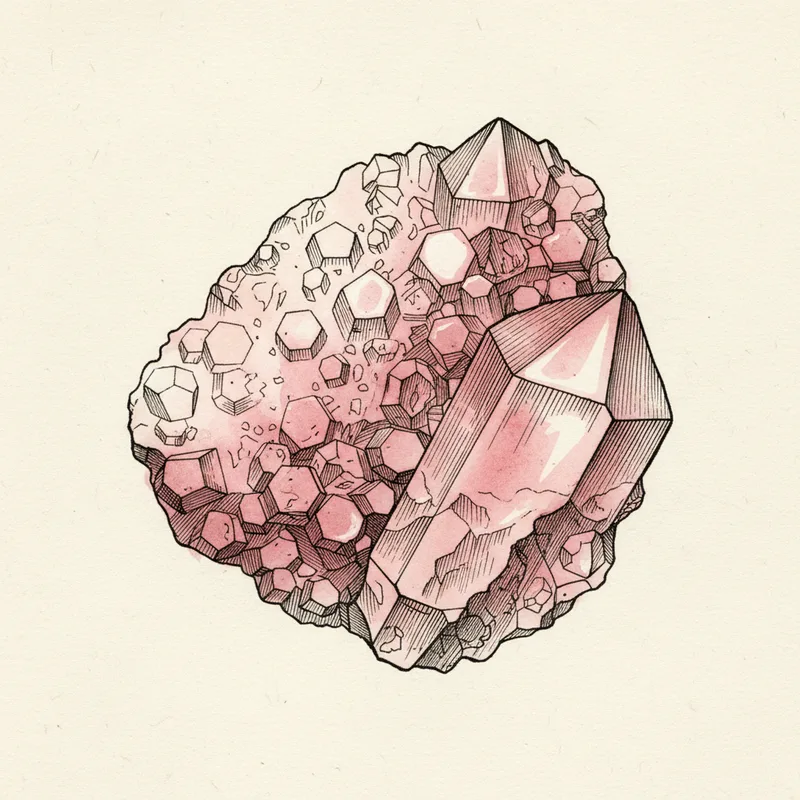
This is why rose quartz almost never forms well-defined crystals - the dense network of dumortierite inclusions disrupts the crystallization process, causing the quartz to grow as massive (non-crystalline) chunks rather than pointed crystals. When distinct rose quartz crystals do occur (extremely rare, mostly from Brazil), they're highly prized by collectors.
In some specimens, the dumortierite inclusions are aligned in specific directions, creating a star effect (asterism) when the stone is cut into a cabochon and viewed under a single light source. Madagascar produces the finest star rose quartz, with sharp six-rayed stars visible in translucent pink stones.
Identification Guide
Rose quartz is identified by its translucent pink color and massive habit. Unlike amethyst or citrine, it rarely forms pointed crystals. The pink is usually soft and even - not banded or zoned like agate. At Mohs 7, it's hard and durable.
Distinguish from pink tourmaline (which forms distinct crystals and is typically more saturated), rhodonite (opaque with black manganese veining), and rhodochrosite (banded pink and white, softer). The translucent, milky quality of rose quartz is quite distinctive - it often has a slightly cloudy or 'sleepy' appearance compared to the water-clarity of amethyst.
Spotting Fakes
Rose quartz is abundant enough that outright faking is rare, but dyed quartz and glass imitations exist in the bead market. Genuine rose quartz has a soft, slightly milky translucency - if a specimen is perfectly clear and bright pink, it may be dyed rock crystal or synthetic. Check for color concentrated in cracks (a dye indicator). Cherry quartz (a bright pink glass with bubbles and swirls) is commonly sold alongside genuine rose quartz - it's manufactured glass, not a natural mineral. Heat-treated rose quartz may lose its color over time with prolonged sun exposure.
Cultural & Metaphysical Traditions
Presented as cultural traditions, not scientific evidence
Rose quartz has been associated with love and beauty since antiquity - ancient Roman and Egyptian civilizations used it in facial masks, believing it prevented aging. Greek myth connects it to Aphrodite, whose blood stained white quartz pink when she cut herself rushing to save her lover Adonis. It remains the bestselling crystal in the wellness market today, associated with self-love, emotional healing, and romantic relationships.
Where It's Found
Largest global producer, massive and rare crystal forms
Star rose quartz with strong asterism
Large translucent masses, historically significant
Fine quality pink material, sometimes gem-grade
Price Guide
Good to Know
Scratch test: At hardness 7, Rose Quartz can scratch glass and steel. It's durable enough for any type of jewelry.
Sources: Found in 4 notable locations worldwide, from Brazil to Namibia.
Heft test: Rose Quartz has average mineral density (2.65). It feels about as heavy as you'd expect from a stone its size.
Explore More
Quartz & Chalcedony
The Love Collection
The universal love stone. Ancient Egyptians placed rose quartz face masks in tombs. Romans and Greeks associated it with Aphrodite/Venus.
The Beginner's Collection
Pink quartz colored by dumortierite fibers or phosphorus impurities (scientists are still refining this). Teaches you that the same mineral formula (SiO₂) can produce completely different appearances.
The Healing Collection
Ancient Egyptian and Roman beauty rituals used rose quartz in facial treatments. Its association with self-compassion in modern practice extends a tradition of gentle, nurturing application.
The Grief Collection
The stone of self-compassion. Grief requires turning gentle attention toward oneself. Rose quartz's soft pink and association with unconditional love supports the self-care that grief demands.
Best Crystals for Grief and Loss
Taurus Season Crystals: 6 Stones for Stability and Abundance
Spring Crystal Rituals: Stones for New Beginnings
Mohs Hardness Scale
See where Rose Quartz sits on the scale
Crystal Care Guide
Water safety, sunlight, and handling tips
Stay in the loop
From the Almanac
Updates from Crystal Almanac, when there’s something worth sharing.