Amethyst vs Fluorite: How to Tell the Difference
Key Takeaway: The fastest way to distinguish amethyst from fluorite is the hardness test. Amethyst (hardness 7) cannot be scratched by a steel knife. Fluorite (hardness 4) can be scratched easily. They also differ in crystal shape, cleavage, and UV response.
Purple amethyst and purple fluorite can look strikingly similar - both form gorgeous crystals in shades of violet, lavender, and deep purple. But they're completely different minerals with different chemistry, different formation processes, and very different values. Here's how to tell them apart, even without any equipment.
The Quick Answer
If you only remember one thing: scratch it with a knife. A steel blade (hardness ~5.5) will scratch fluorite easily but won't leave a mark on amethyst. This single test is definitive and takes five seconds.
Crystal Shape
Amethyst and fluorite grow in completely different crystal systems, which means their natural shapes are different.
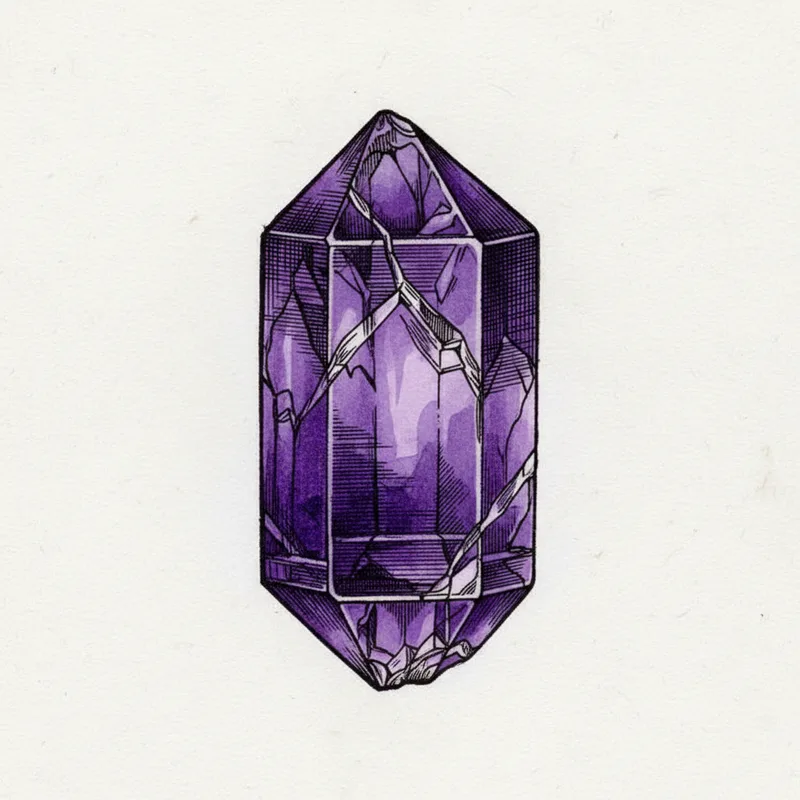
Amethyst belongs to the trigonal crystal system. It forms six-sided (hexagonal) prisms that taper to a point. If you look at the cross-section of an amethyst crystal, it's a hexagon. The prism faces often show horizontal striations - fine parallel lines running across them.
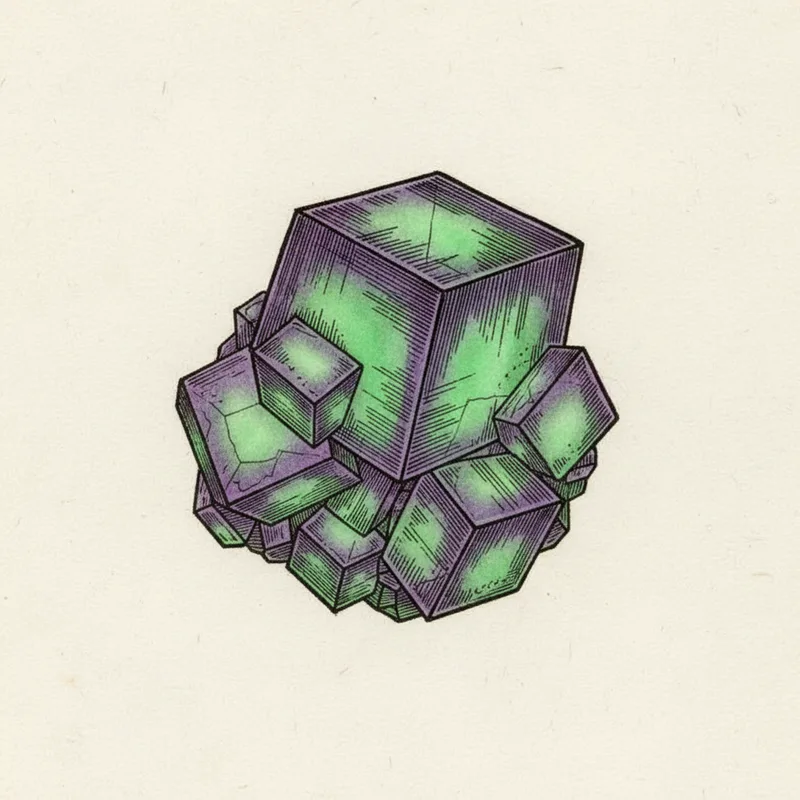
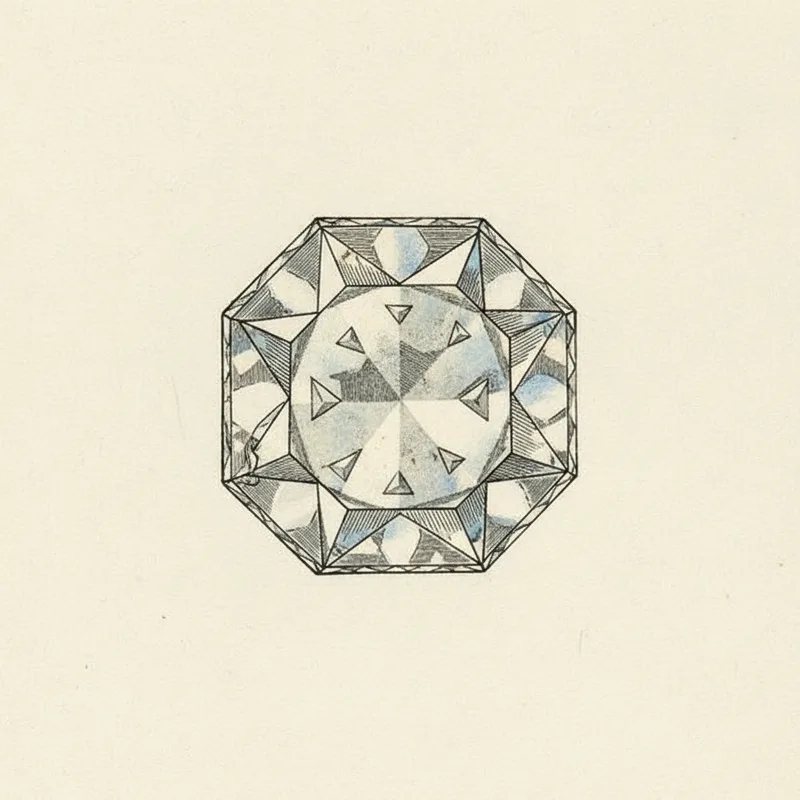
Fluorite belongs to the cubic crystal system. It forms cubes, octahedrons (eight-faced shapes like two pyramids stuck together), or combinations of both. You'll never see a hexagonal fluorite crystal, and you'll never see a cubic amethyst.
When both minerals are tumbled, carved, or polished into shapes, this diagnostic feature disappears - which is when the other tests become important.
Hardness
This is the most reliable and practical test.
Amethyst is hardness 7 on the Mohs scale. It will scratch glass. A steel knife cannot scratch it. It's a durable stone suitable for rings and daily-wear jewelry.
Fluorite is hardness 4 on the Mohs scale. A steel knife scratches it easily. Your teeth could theoretically scratch it (though please don't try). Fluorite is fragile enough that it's rarely used in rings or bracelets - it's primarily a collector's and display mineral.
This hardness difference is enormous in practical terms. If you drag a knife blade across an inconspicuous area and it leaves a visible scratch, it's fluorite (or something else soft). If the knife slides without marking the surface, it's amethyst or another hard mineral.
Cleavage vs Fracture
Fluorite has perfect octahedral cleavage - it breaks along four smooth, flat planes. If you've ever seen fluorite fragments, they tend to be triangular or diamond-shaped with flat, smooth faces. This is one of fluorite's most distinctive properties.
Amethyst has no cleavage at all. It fractures conchoidally - producing curved, shell-like surfaces similar to broken glass. If you see a broken surface that's curved and glassy, it's quartz-family. If you see flat, smooth break surfaces at consistent angles, it's likely fluorite.
Color Differences
Both minerals can be purple, but the shade and distribution of color often differ.
Amethyst purple tends to be warmer - more reddish-purple or violet. It frequently shows color zoning, with angular bands of lighter and darker purple visible when you look through the crystal. The color is caused by iron impurities and radiation.
Fluorite purple tends to be cooler - more blue-purple. Fluorite also shows color zoning but typically in wider bands, and a single specimen can display multiple distinct colors (purple, green, blue, yellow) in ways amethyst never does. Fluorite's color comes from structural defects in the crystal lattice, not from chemical impurities.
If a purple stone shows bands of green or blue mixed in with the purple, it's almost certainly fluorite. Amethyst doesn't do that.
UV Response
Many fluorite specimens fluoresce under ultraviolet light - glowing vivid blue, purple, or green. In fact, the word "fluorescence" was coined specifically to describe this phenomenon in fluorite.
Amethyst generally does not fluoresce, or shows only weak response. If you have a UV flashlight (they're cheap and useful), this can be a helpful supplementary test - though not all fluorite fluoresces, so a negative result doesn't rule it out.
Weight
Fluorite is noticeably denser than amethyst. Fluorite has a specific gravity of 3.18, while amethyst is 2.65. If you hold similar-sized specimens of each, fluorite feels heavier than you'd expect for its size. This isn't a precise test, but with practice, the weight difference becomes noticeable.
Price and Market Context
Amethyst is generally more valuable than fluorite in the gem and jewelry market because it's harder and more durable. However, exceptional fluorite specimens - particularly those from famous localities like Rogerley Mine in England, or those showing rare colors - can command higher prices than common amethyst.
In the bead and tumbled stone market, both are affordable. If someone is selling "amethyst" beads at unusually low prices, they might actually be fluorite - which would be softer and less durable for jewelry use. The scratch test resolves this instantly.
Side-by-Side Summary
| Property | Amethyst | Fluorite |
|---|---|---|
| Hardness | 7 (can't scratch with knife) | 4 (easily scratched) |
| Crystal shape | Hexagonal prisms | Cubes and octahedrons |
| Cleavage | None (conchoidal fracture) | Perfect octahedral |
| Color range | Purple only | Purple, green, blue, yellow, clear |
| UV response | Usually none | Often strong fluorescence |
| Specific gravity | 2.65 | 3.18 |
| Durability | Excellent for jewelry | Too fragile for most jewelry |
| Chemical formula | SiO₂ | CaF₂ |
FAQ
Can fluorite be used in jewelry? It can be set in earrings or pendants (which don't take daily impact), but it's too soft and cleavage-prone for rings or bracelets. If you see a "purple gemstone ring" at a very low price, check whether it's fluorite rather than amethyst - the durability difference matters for daily wear.
Is one more "valuable" than the other? For jewelry, amethyst is more valuable because of its durability. For mineral collecting, it depends entirely on the specimen. A world-class fluorite from the Rogerley Mine can be worth far more than a common amethyst cluster.
Can they occur together? Yes. Amethyst and fluorite occasionally occur in the same geological environments, and you can find specimens with both minerals present. They form under different conditions, but hydrothermal veins can produce both.
I have a purple stone and I'm not sure what it is. What should I try first? The knife scratch test. Five seconds, completely definitive. If the knife scratches it, it's fluorite (or something else soft). If not, it's likely amethyst. Then check for cleavage, crystal shape, and UV response to confirm.
Crystals in This Article
Keep Reading
Stay in the loop
From the Almanac
Updates from Crystal Almanac, when there’s something worth sharing.