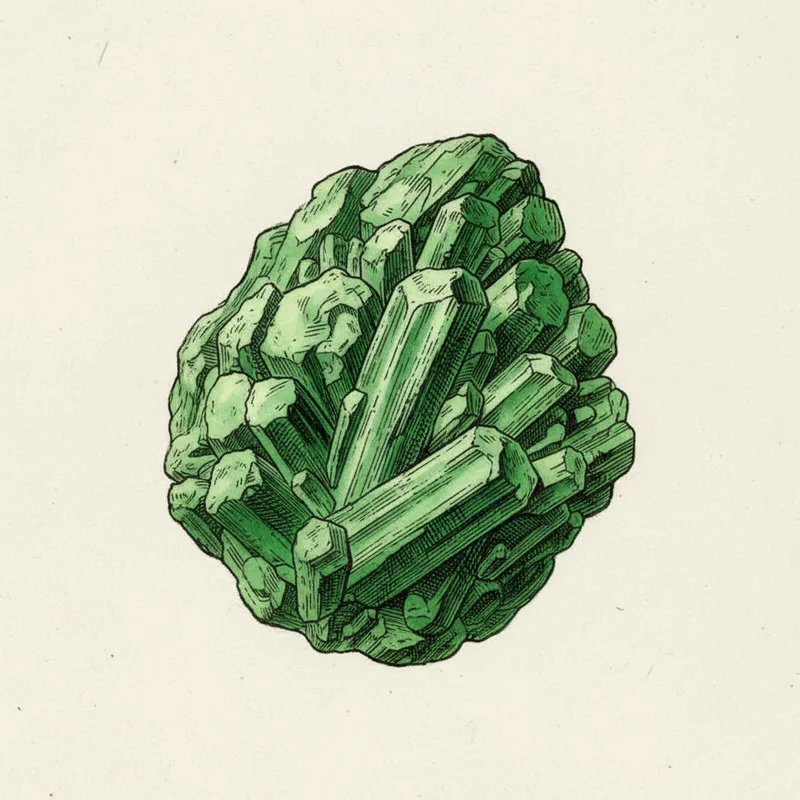
Quick Facts
Formation & Origin
What we call 'jade' is actually two completely different minerals that happen to look similar: jadeite (a pyroxene) and nephrite (an amphibole). They weren't distinguished as separate minerals until 1863.
Nephrite forms in metamorphic environments when calcium and magnesium-rich rocks (like serpentinite) are altered by heat and pressure. Its extraordinary toughness - greater than steel - comes from its microstructure: interlocking bundles of microscopic fibrous crystals that resist fracture the way a rope resists breaking. This is why nephrite was prized for tools and weapons before metallurgy.
Jadeite forms under extreme conditions - high pressure but relatively low temperature - typically in subduction zones where oceanic crust dives beneath continental plates. These conditions are geologically rare, which is why gem-quality jadeite is found in very few places on Earth. The finest 'Imperial jade' - translucent, vivid emerald green, colored by chromium - comes exclusively from Myanmar and commands prices exceeding $3 million per kilogram at auction.
Identification Guide
Jade's most distinctive property is its exceptional toughness - it's harder to break than any common gemstone, including diamond. A genuine jade piece rings when tapped and feels dense and cool in the hand. Jadeite (SG 3.30) is noticeably denser than nephrite (SG 2.95).
Distinguishing jadeite from nephrite without gemological equipment is difficult. Jadeite tends to have a slightly more vitreous, glassy luster and can achieve brighter, more saturated colors, especially green. Nephrite typically has a more oily or waxy luster and appears in more muted tones. The many jade imitations (serpentine, aventurine, chrysoprase, glass) make laboratory testing essential for valuable pieces.
Spotting Fakes
Jade fraud is a massive problem in the market. Common substitutes include serpentine (much softer), aventurine quartz, dyed quartzite, chrysoprase, and glass. 'B jade' is genuine jadeite that has been acid-bleached to remove brown staining and then polymer-impregnated to improve appearance. 'C jade' is dyed. Only 'A jade' is untreated. For any significant purchase, demand a lab report from a recognized gemological laboratory. The scratch test is unreliable - some fakes match jade's hardness. The best field test is density - jade feels heavy for its size.
Cultural & Metaphysical Traditions
Presented as cultural traditions, not scientific evidence
Chinese civilization has revered jade for over 8,000 years - longer than any other gemstone tradition on Earth. Confucius compared jade's qualities to virtue, and jade burial suits were crafted for Han dynasty royals. Maori carve nephrite (pounamu) into hei-tiki pendants passed down through generations. Maya civilization considered jade more precious than gold. Modern Feng Shui associates jade with prosperity, longevity, and harmony.
Where It's Found
Only significant source of gem-grade jadeite
Nephrite jade, revered for 8,000+ years
Maya jade source, rediscovered in 1974
Pounamu nephrite, sacred to Maori culture
Price Guide
Good to Know
Scratch test: At hardness 6.5, Jade resists scratching from a knife but can be scratched by quartz. Best for pendants and earrings rather than rings.
Sources: Found in 4 notable locations worldwide, from Myanmar to New Zealand.
Heft test: Jade has average mineral density (3.30 (jadeite) / 2.95 (nephrite)). It feels about as heavy as you'd expect from a stone its size.
Related Minerals
Common jade imitation, much softer
Green chalcedony, similar color
Sparkly green quartz, common substitute
Related pyroxene, sometimes called 'omphacite jade'
Explore More
Other Silicates & Gems
The Abundance Collection
More valuable than gold in imperial Chinese culture. Associated with prosperity, longevity, and nobility for over 5,000 years.
Malachite vs Chrysoprase: Two Very Different Greens
Best Crystals for Grief and Loss
Best Crystals for Manifestation: A Practical Guide
Mohs Hardness Scale
See where Jade sits on the scale
Crystal Care Guide
Water safety, sunlight, and handling tips
Stay in the loop
From the Almanac
Updates from Crystal Almanac, when there’s something worth sharing.