Quick Facts
Formation & Origin
Native copper - pure metallic copper occurring in its elemental form - is geologically uncommon. Most of the world's copper is extracted from sulfide and oxide ores, not native metal. The most extraordinary exception is Michigan's Keweenaw Peninsula, which produced more native copper than the rest of the world combined.
The Michigan copper formed about 1.1 billion years ago when basaltic lava flows were infiltrated by copper-bearing hydrothermal fluids. The copper precipitated in gas cavities (vesicles) within the basalt and in the porous tops between individual lava flows. Some native copper masses from Michigan weigh hundreds of tons - the largest single piece ever found (the Ontonagon Boulder) weighs over 1,600 kilograms.
Native copper was humanity's first metal. The Copper Age (Chalcolithic period, roughly 5500-3000 BCE) began when people discovered that native copper nuggets could be hammered into tools and ornaments without smelting. Michigan's copper was traded across prehistoric North America through extensive indigenous trade networks thousands of years before European contact.
Identification Guide
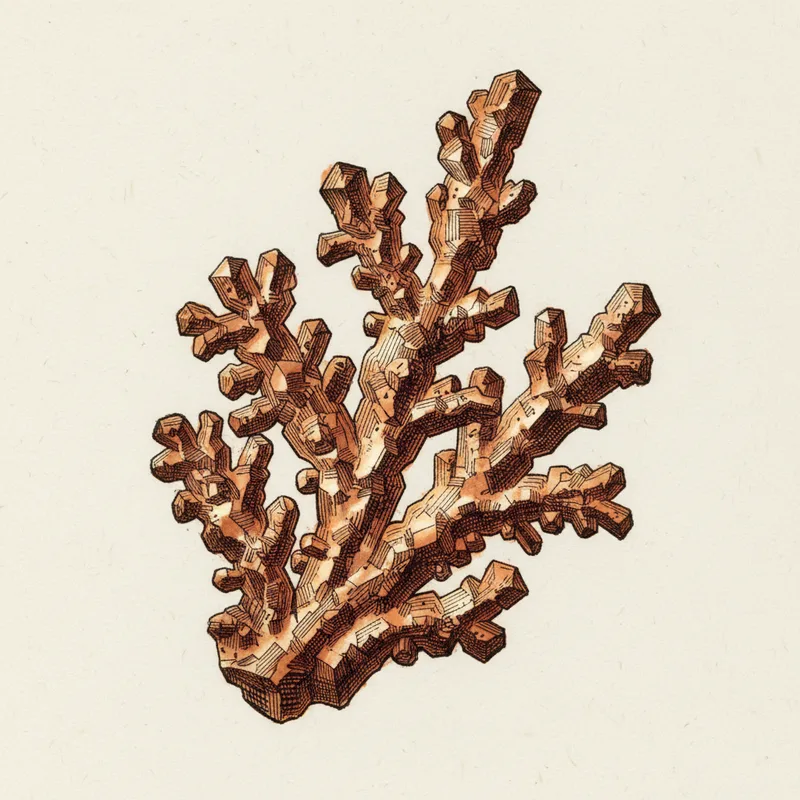
Native copper is identified by its distinctive copper-red color on fresh surfaces, malleability, high density (8.94), and copper-red streak. It tarnishes to brown, then eventually develops green patina (copper carbonate/sulfate) with exposure to air and moisture.
Distinguish from copper-bearing minerals like chalcopyrite (brassy yellow, harder), bornite (iridescent tarnish but purple-blue, not copper-colored), and cuprite (red copper oxide, harder, non-malleable). Native copper bends without breaking - if a reddish metallic specimen snaps when bent, it's not native copper.
Spotting Fakes
Native copper specimens from Michigan are abundant and affordable for most sizes, so faking is uncommon. Extremely large or well-crystallized specimens command premium prices and are worth verifying. Some sellers clean copper specimens aggressively with acid, removing the natural patina to show bright metal - this is a matter of collector preference rather than deception. Green-patinated specimens are sometimes artificially patinated with chemicals for aesthetic purposes.
Cultural & Metaphysical Traditions
Presented as cultural traditions, not scientific evidence
Copper has been associated with Venus/Aphrodite since antiquity - the chemical symbol Cu comes from 'cuprum,' named after the island of Cyprus where the Romans mined it and which was sacred to Aphrodite. In Ayurvedic tradition, drinking water stored in copper vessels is believed to have health benefits (copper does have antimicrobial properties). Ancient Egyptians used copper tools in pyramid construction. Modern crystal practitioners associate copper with energy amplification, channeling, and communication.
Where It's Found
World's greatest native copper deposits, massive specimens
Fine crystalline specimens
Classic European source
Crystallized specimens in sandstone
Price Guide
Good to Know
Scratch test: At hardness 2.5, Native Copper can be scratched with a fingernail. This is a display specimen, not a wearable stone.
Sources: Found in 4 notable locations worldwide, from United States to Bolivia.
Heft test: With a specific gravity of 8.94, Native Copper feels surprisingly heavy for its size. This weight is actually a useful identification tool.
Explore More
Native Elements & Metals
Best Crystals for Confidence and Self-Esteem
How to Store and Display Your Crystal Collection
Best Crystals for New Year Intentions 2026
Mohs Hardness Scale
See where Native Copper sits on the scale
Crystal Care Guide
Water safety, sunlight, and handling tips
Stay in the loop
From the Almanac
Updates from Crystal Almanac, when there’s something worth sharing.