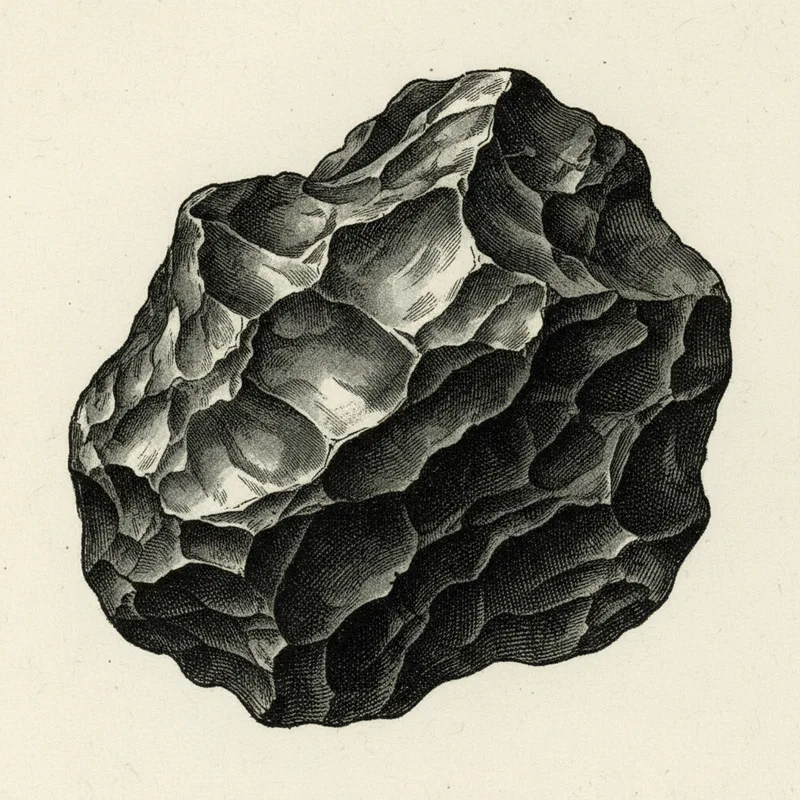
Quick Facts
Formation & Origin
Shungite is a carbon-rich rock found almost exclusively in the Shunga region of Karelia, Russia. It's approximately 2 billion years old - Precambrian - making it one of the oldest carbon-bearing rocks on Earth. The exact origin of its carbon is debated: it may derive from ancient microbial mats (colonial organisms that predated complex life) or from migrated hydrocarbons.
What makes shungite scientifically notable is its content of fullerenes - hollow, cage-like carbon molecules (including C60, known as 'buckyballs'). Shungite is one of the only known natural sources of fullerenes, which were first synthesized in a laboratory in 1985 and earned their discoverers a Nobel Prize. However, the fullerene content is very small (typically less than 0.1% by weight), and whether this has any practical significance outside a laboratory is questionable.
Shungite is classified into types based on carbon content. 'Elite' or 'noble' shungite (Type I) contains 90-98% carbon and has a distinctive semi-metallic, silvery-black appearance. Regular shungite (Type III) contains 30-50% carbon and is matte black. The vast majority of shungite on the market is Type III.
Identification Guide
Shungite is identified by its black color, low density (it feels lighter than most black minerals), and ability to conduct electricity (one of the few non-metallic rocks that does). The conductivity test is the most practical - real shungite will complete a circuit with a simple multimeter or battery-and-LED setup.
Distinguish from black tourmaline (striated crystals, doesn't conduct electricity), obsidian (glassy, much denser), jet (organic, very lightweight), and black onyx (banded, harder). Elite shungite has a distinctive semi-metallic, conchoidal fracture surface that's unlike any other black mineral.
Spotting Fakes
The conductivity test is the gold standard for shungite verification. Genuine shungite conducts electricity; black tourmaline, obsidian, onyx, and most black rocks do not. If a seller won't let you test conductivity, be suspicious. Carbon-based fakes (like coal or charcoal) also conduct but have different density and fracture patterns. 'Elite shungite' at suspiciously low prices may be regular shungite or even painted rock - elite shungite's semi-metallic luster and conchoidal fracture are distinctive.
Cultural & Metaphysical Traditions
Presented as cultural traditions, not scientific evidence
Shungite has become one of the most heavily marketed crystals in the EMF-protection space. Sellers claim it shields against electromagnetic radiation from phones, Wi-Fi, and electronics. There is no peer-reviewed evidence supporting this claim. While shungite does conduct electricity (a real physical property), conductivity does not equate to EMF shielding capability. Peter the Great of Russia reportedly ordered the first spa built at the Karelian shungite deposits, and Russian folk tradition associates the local water (which filters through shungite deposits) with healing properties.
Where It's Found
The only significant source, 2 billion years old
Price Guide
Good to Know
Scratch test: At hardness 3.5, Shungite can be scratched with a copper coin. Handle gently and keep away from harder stones in your collection.
Sources: Found at only one location on Earth - Russia. Supply is inherently limited.
Heft test: With a specific gravity of 1.80-2.40, Shungite feels lighter than most minerals. This lightness can help identify it.
Related Minerals
Another black organic material, from fossilized wood
High-carbon rock, similar appearance
Black volcanic glass, different origin entirely
Black crystal, doesn't conduct electricity
Explore More
Rocks & Multi-Mineral Composites
The Protection Collection
Peter the Great established the first Russian spa at Karelian shungite deposits. Russian folk tradition associates it with purification.
The Grounding Collection
2 billion years old. The sheer geological age of this carbon-rich rock connects it to deep Earth history.
The Travel Collection
Carried by modern travelers for EMF protection from airport scanners and long flights. While the EMF claims aren't scientifically substantiated, its Karelian origin and 2-billion-year age make it a compelling travel companion.
The Workplace Collection
Placed near computers and screens in modern crystal tradition for EMF protection. The conductivity claims aren't proven, but its matte black appearance and 2-billion-year age give it significant desk presence.
Taurus Season Crystals: 6 Stones for Stability and Abundance
Protection Crystals Explained by Science
How to Start a Crystal Collection on Any Budget
Mohs Hardness Scale
See where Shungite sits on the scale
Crystal Care Guide
Water safety, sunlight, and handling tips
Stay in the loop
From the Almanac
Updates from Crystal Almanac, when there’s something worth sharing.