Rose Quartz vs Pink Amethyst: The Pink Quartz Debate
Key Takeaway: Both are pink varieties of quartz, but they form in completely different geological environments and have distinct crystal habits and colors. Rose quartz is cloudy and massive, while pink amethyst forms sparkling crystals inside geodes.
Rose quartz is a cloudy, massive form of quartz colored by microscopic fibrous inclusions, rarely forming visible crystals. "Pink amethyst" is a recently discovered variety of quartz from Patagonia that forms distinct, sparkling pink crystals inside geodes, colored by inclusions of hematite.
At a Glance
| Feature | Rose Quartz | Pink Amethyst |
|---|---|---|
| Hardness | 7 | 7 |
| Chemical Formula | SiO₂ (with Dumortierite) | SiO₂ (with Hematite) |
| Crystal System | Trigonal | Trigonal |
| Color Range | Pale milky pink to deep rose | Dusty pink, lilac-pink, peach |
| Price Range | $4 to $15 per pound | $20 to $50 per pound |
| Best For | Tumbled stones, large carvings, cabochons | Geode display specimens, faceted gems |
How They Form
Rose quartz is a macroscopic quartz that forms almost exclusively in the high-temperature cores of pegmatites. It forms large, solid masses without distinct crystal faces. For decades, the exact cause of its pink color was a mystery. Scientists eventually discovered that the cloudy, uniform pink hue is caused by dense networks of microscopic, pink dumortierite-like fibers that grew alongside the quartz. Because of these fibrous inclusions, rose quartz is almost always cloudy or milky.
"Pink amethyst" is a trade name for a specific type of pink quartz discovered recently in the Choique Mine in Patagonia, Argentina. Geologically, calling it amethyst is slightly controversial, as amethyst is defined by its iron color centers. Pink amethyst forms in volcanic geodes, exactly like purple amethyst, but its color comes from microscopic inclusions of iron oxide, specifically hematite, suspended within the crystal lattice.
How to Tell Them Apart
The structural difference is the most obvious giveaway. Rose quartz is almost always found in massive chunks. If you buy rose quartz, you are likely buying a carved shape, a tumbled stone, or a raw, broken rock face. It very rarely forms distinct, geometric crystal points.
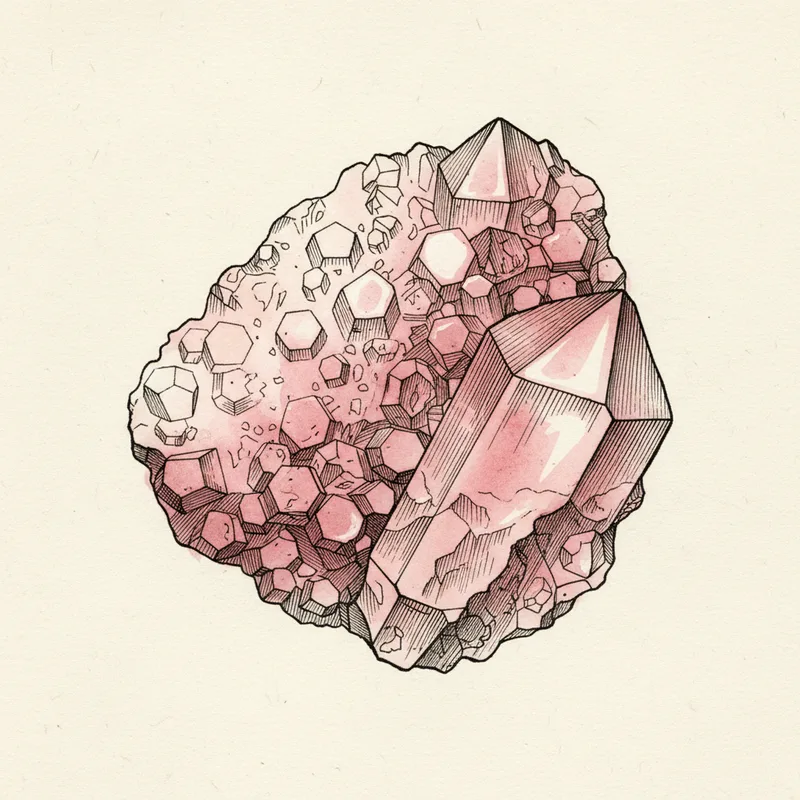
Pink amethyst, because it grows inside geodes, is covered in hundreds of tiny, distinct crystal terminations that sparkle in the light. It looks exactly like an amethyst geode, but pink. Color-wise, rose quartz has a true, milky baby-pink hue. Pink amethyst tends to have a dustier, sometimes peach or lilac undertone due to the hematite.
Price & Value
Both stones are relatively affordable. Rose quartz is mined in massive quantities, particularly in Brazil and Madagascar. It is a staple of the gem trade and is very inexpensive, though highly translucent pieces with a very deep, saturated pink color known as "star rose quartz" can fetch higher prices.
Pink amethyst is slightly more expensive simply because it is a newer discovery and comes from a specific locality. It is sold primarily as display geodes or slabs rather than individual cut gemstones. The value is determined by the size of the geode, the sparkle of the drusy crystals, and the saturation of the pink color.
Which Should You Choose?
If you want classic pink jewelry, smooth polished stones, or large, affordable decorative carvings, rose quartz is the traditional and reliable choice. If you are a mineral collector looking for a sparkling, geode-style display piece with a unique, dusty pink hue, pink amethyst makes a beautiful and trendy addition to a rock shelf.
Crystals in This Article

Keep Reading
Stay in the loop
From the Almanac
Updates from Crystal Almanac, when there’s something worth sharing.